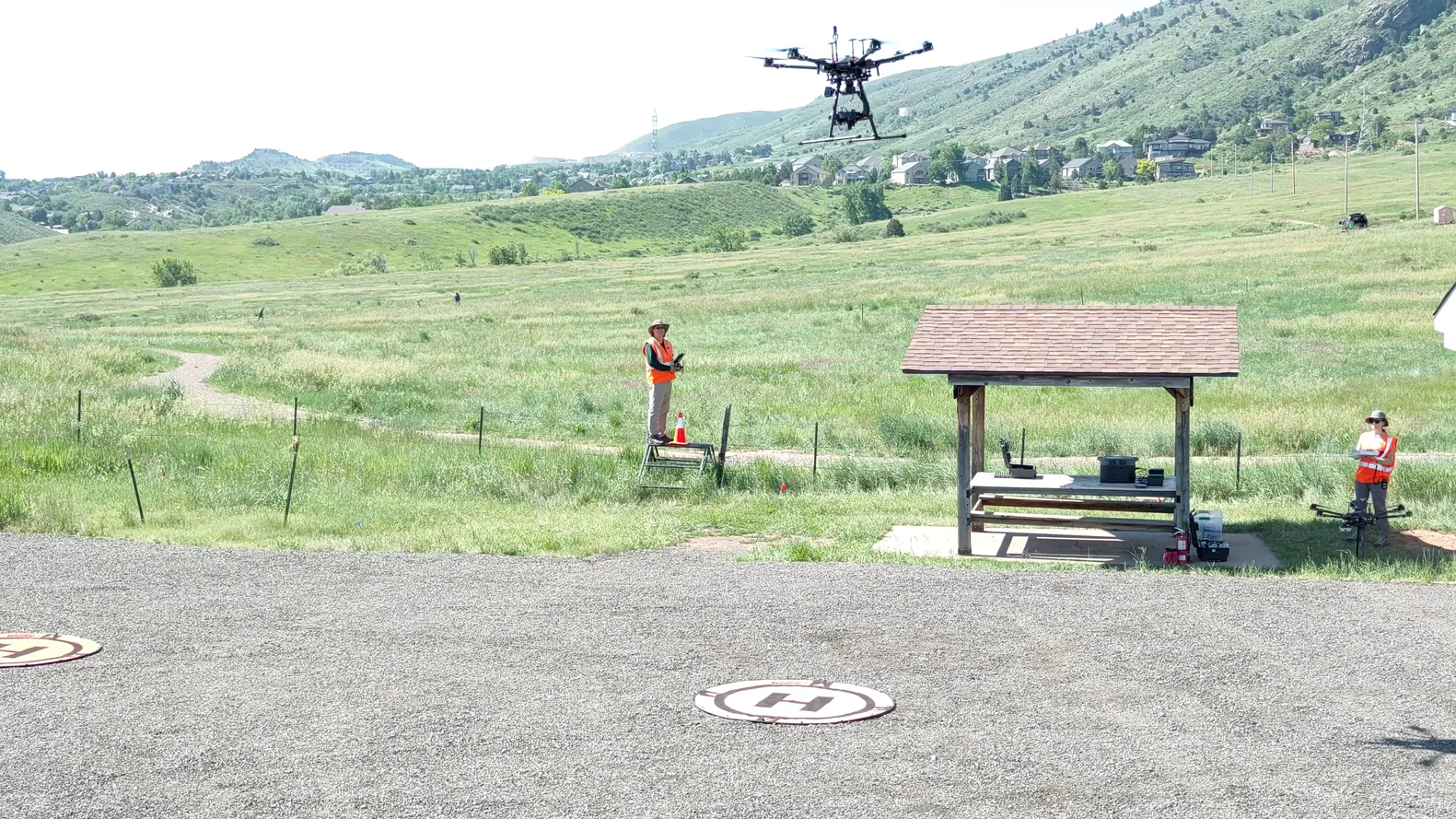
A drone risk assessment identifies what could go wrong during a particular flight, how serious the consequences could be, and what the crew will do to reduce the risk. A useful record connects each hazard to a specific control, a person responsible for it, and a condition that stops the operation. Complete it during planning, verify it at the site, and revisit it when conditions change.
The template below is for U.S. civil small-drone operations under Part 107. It combines a mission summary, repeatable hazard entries, and a recorded go/no-go decision. Use it alongside your aircraft checklist and operating procedures. It is an adaptable working form, not an FAA approval or a substitute for required permissions.
On This Page
- Separate the required assessment from the form
- Gather the mission inputs first
- Copy this drone risk assessment template
- Assess likelihood, consequences, and remaining risk
- Work through a roof-survey example
- Brief, monitor, and keep the decision record
Separate the required assessment from the form
Under 14 CFR 107.49, the remote pilot in command (RPIC) must assess local weather, airspace and restrictions, people and property, and other ground hazards before flight. The same section requires briefing direct participants, checking control links, ensuring sufficient power, securing carried equipment, and confirming applicable aircraft eligibility for operations over people.
Sections 107.15 and 107.19 also require a safe-condition check before each flight and place final operational responsibility with the RPIC. A supervisor's signature cannot transfer that responsibility.
The regulation does not prescribe this worksheet or a universal numeric risk score. The FAA's AC 107-2A, Appendix A, provides an example assessment and explicitly describes its format as optional. Appendix E supplies a separate sample preflight checklist. Your waiver, authorization, employer procedures, or contract may impose additional documentation requirements.
The distinction matters in practice: a checklist confirms that a task was done; the assessment explains whether the resulting conditions are acceptable for this mission. “Control link checked” is incomplete if a building will obstruct that link along the planned route.
Gather the mission inputs first
Prepare a marked site map, the intended flight boundaries and height, launch and recovery locations, aircraft and payload details, crew assignments, and the actual operating documents. Include the return route and alternate landing areas, not just the path that collects the data.
Before rating hazards, resolve these prerequisites:
- Pilot and aircraft: Confirm the RPIC's certificate and applicable knowledge recency, aircraft registration, configuration, safe condition, and relevant operating instructions. Review fitness, task proficiency, and unfamiliar equipment separately from certificate status.
- Operating authority: Confirm the mission fits the applicable rules and any issued waiver. The FAA's Part 107 waiver guidance explains the separate process for deviations from waivable rules. Completing a risk form does not grant a deviation.
- Airspace: Determine the airspace and current restrictions. Where authorization is required, match the issued approval to the location, time, and altitude. The FAA's airspace authorization guidance describes LAANC and DroneZone. A request awaiting approval cannot serve as a launch permission.
- Remote ID: Confirm the aircraft's applicable compliance method and configuration using the FAA's Remote Identification guidance. Airspace approval does not establish Remote ID compliance.
- Site conditions: Obtain site access arrangements, current weather information, and a walk-through of people, vehicles, obstacles, terrain, and emergency access. Identify which conditions you can control and which you must monitor.
Record the source and time of weather and restriction checks. An assessment prepared in the office needs an on-site update if the forecast, access arrangements, or flight footprint has changed.
Copy this drone risk assessment template
Copy both tables into your job record. Complete one mission summary and a separate hazard entry for each significant hazard. Replace the prompts with observations and decisions; an unresolved safety-critical field means the assessment is unfinished.
These are suggested record fields adapted from the assessment topics in AC 107-2A, Appendix A, and the duties in section 107.49. Control owners, verification times, and reassessment triggers are practical additions for following through on the assessment.
Mission summary
| Field | Information to record |
|---|---|
| Job and revision | Job identifier; assessment version; preparer; date and time with time zone |
| Mission and boundaries | Task; site coordinates or address; attached map; flight area; maximum planned height; launch, recovery, and alternate landing areas |
| Aircraft and crew | Aircraft identifier; payload and configuration; checklist/manual version; RPIC; other crew and assigned duties |
| Permissions and prerequisites | Applicable operating authority; authorization or waiver reference and conditions; registration and Remote ID checks; site access arrangements |
| Conditions and limits | Weather source and check time; site observations; aircraft, pilot, and organizational limits; return and landing criteria |
| Unresolved items | Missing information, failed checks, unavailable controls, or conditions requiring a hold |
| Flight decision | Go, hold, or cancel; reasons; unresolved actions; RPIC name and time; additional review required by your procedures |
| Validity and updates | Flight or mission segment covered; conditions that require reassessment; revision reference after a change |
Repeatable hazard entry
| Field | Information to record for this hazard |
|---|---|
| Hazard and exposure | What could initiate an unsafe event; when and where it could occur; people, aircraft, or property exposed |
| Cause and consequence | Why it could happen and the credible harm if it does |
| Initial assessment | Likelihood and severity before the proposed additional controls; supporting observations; existing controls assumed |
| Preventive control | Specific change to route, timing, equipment, staffing, or access that reduces exposure or event likelihood |
| Owner and verification | Person responsible; how the control will be checked; completion time and result |
| Remaining risk | Likelihood and severity after verified controls; what remains possible; uncertainties and dependencies |
| Stop trigger and response | Observable condition requiring action; who calls it; briefed contingency or emergency response |
| Disposition | Accept under the operator's criteria, revise and reassess, or stop; reviewer and decision time |
Write “access lead confirms the agreed entry points are controlled before arming” instead of “manage public access.” Write the actual approved ceiling and planned return settings in the job record instead of “check height.” Specific wording lets the next crewmember confirm whether a control exists.
Assess likelihood, consequences, and remaining risk
Start with the whole operation: pilot readiness, aircraft and payload, the environment, and pressure to finish. Walk through setup, takeoff, the task, return, landing, and recovery. AC 107-2A recommends identifying causes and effects, estimating likelihood and severity, selecting mitigations, and planning a response if a hazard occurs despite those mitigations.
Likelihood describes how plausible the event is in these conditions. Severity describes how harmful its consequences could be. Residual risk is what remains after the controls are in place. A trained observer may make an approaching hazard easier to detect; that does not automatically make an aircraft impact less severe.
Use your organization's defined matrix and escalation rules if it has them. Record the matrix version and the reason for each rating. Keep initial and residual ratings separate, and lower a rating only when a verified control supports the change. Avoid inventing a percentage or assigning “rare” simply because the crew has never experienced the event.
For an operator developing a process, begin with written likelihood and consequence judgments, then establish consistent rating definitions and review responsibilities before relying on a score. The following decisions can organize that discussion:
| Assessment finding | Practical disposition |
|---|---|
| A required permission, legal condition, or safe-aircraft check is unresolved | Hold; resolve the prerequisite or change the mission before reassessing |
| A proposed control has no owner or cannot be verified | Hold; it cannot yet support a lower residual-risk judgment |
| Material uncertainty remains about a serious consequence | Seek competent review or additional information; reduce exposure or postpone |
| Controls are verified and remaining risk meets the operator's established criteria | RPIC considers the complete mission and makes the flight decision |
This table is a suggested decision sequence, not a regulatory risk classification. The FAA Safety Team's Flight Risk Assessment Tool guidance explains that a score assists the pilot's decision; it does not make it. A favorable total cannot compensate for a missing authorization or an unsafe aircraft.
Check how hazards interact. A gustier return leg may demand more pilot attention at the same time a person approaches the landing area. If one crewmember is expected to monitor both, the controls may depend on more attention than that person can provide. Change the staffing or flight plan rather than counting the same attention twice.
Work through a roof-survey example
Consider a hypothetical daylight roof survey beside an occupied delivery yard. The customer wants the entire roof covered, but the original route crosses a service lane. The example below demonstrates the method; it does not establish safe distances, aircraft capability, or approval for a real site.
Hazard: A delivery vehicle or pedestrian enters the area beneath the flight or return path. The cause is an access point that remains in use during the survey. A credible consequence is injury or property damage following an aircraft failure or loss of control.
Initial assessment: Exposure is plausible while deliveries continue. The crew cannot justify treating the area as empty merely because no vehicle was present during setup. Record that uncertainty rather than assigning a reassuring number.
Proposed controls: Arrange an authorized pause in deliveries, establish the agreed access controls with the site representative, and move the flight and return routes away from occupied areas. Assign an access lead who can monitor the agreed entry points and communicate with the RPIC. Before arming, record the site representative's confirmation, the access lead's check of the entry points, and the crew communication check. If control of access is unavailable, revise the task to an area that can be assessed adequately or postpone it.
Residual assessment: Confirm the actual routes and recovery areas fit the revised boundaries. Record why the verified changes reduce the likelihood of exposure while retaining the serious potential consequence of an impact. A person controlling an entry point may reduce exposure, but access control alone does not establish compliance with the rules for flights over people or moving vehicles. Check the applicable Part 107 conditions independently. If the team cannot explain why the remaining risk meets its criteria, the decision stays on hold.
Stop trigger and response: If the agreed area is breached, the access lead calls the briefed alert. The RPIC ends the survey segment and uses the preplanned safe recovery action, accounting for where the person or vehicle is now located. An automatic return path across the breached lane would undermine the control, so review that path in advance.
Add separate entries for weather, power reserve, loss of link, obstacles, and crew workload where they create material risks. Use the actual aircraft instructions and site observations to set limits. Do not copy a wind threshold, battery percentage, or return height from another operator's worksheet.
Brief, monitor, and keep the decision record
Before launch, read back the controls that must remain effective, who monitors them, the stop calls, and the recovery actions. Check that crew members can communicate and perform their assigned tasks. A signature records a decision; the briefing makes that decision usable.
During flight, continue assessing the conditions. Appendix A of AC 107-2A calls for ongoing reassessment. If a condition invalidates the plan, follow the briefed safe response and reassess before resuming. Do not defer that decision merely to finish the current data run.
Revisit the assessment after a route change, aircraft or payload change, crew substitution, changed weather, new people or vehicles, a warning, or a failed control. Between flights, repeat the required safe-condition check and confirm that the assessment still describes the next flight. A battery swap does not reset site hazards.
Keep the mission summary, hazard entries, map revision, permission references, check times, briefing record, and decision together. After landing, add any unexpected event, control failure, or change, plus the person responsible for follow-up. Preserve earlier revisions so the record shows what the crew knew when it made the decision. Set retention and additional reporting requirements from the rules and conditions actually applicable to the operation, along with organizational and contractual requirements.
For the next job, copy the structure and review the hazards again. Reuse a control only after confirming that it fits the new site, aircraft, and crew. The practical test is simple: another qualified operator should be able to read the record, identify what could stop the flight, and see who is watching for it.
Sources
- 14 CFR Part 107, Small Unmanned Aircraft Systems: current regulatory text for RPIC responsibility, preflight duties, aircraft condition, and operational requirements. The eCFR displayed Title 14 as current through September 3, 2026.
- FAA AC 107-2A, Small Unmanned Aircraft System: advisory guidance, especially Appendix A's hazard assessment and mitigation method and Appendix E's sample preflight checklist. Issued February 1, 2021.
- FAA Safety Team, Flight Risk Assessment Tool: guidance on documenting risk, setting review points, and using scores to assist a go/no-go decision.
- FAA Part 107 Waivers: when a waiver may be needed and the requirement to explain operational hazards and mitigations in an application.
- FAA Part 107 Airspace Authorizations: LAANC and DroneZone processes for applicable airspace approvals.
- FAA Remote Identification of Drones: Remote ID applicability and compliance methods.
Last checked: September 8, 2026.