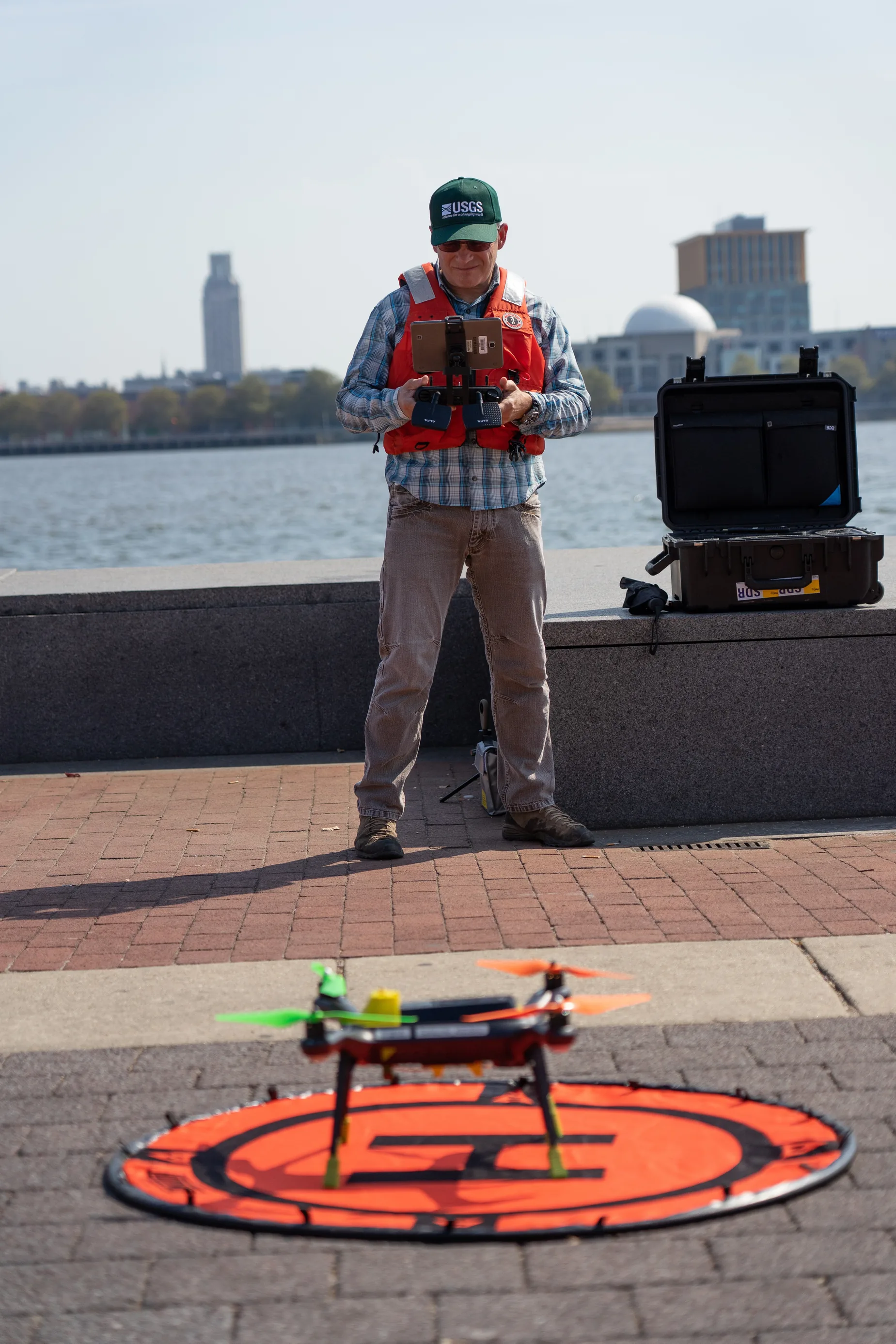
Every drone flown under Part 107 must be registered, including one weighing less than 250 grams. For the usual online registration, the FAA charges $5 per aircraft for three years. Register through the Part 107 option in FAA DroneZone before flying for work. Aircraft registration identifies the drone; it does not grant the pilot a Remote Pilot Certificate or authorize a particular flight. See the FAA's registration guidance.
This guide covers the U.S. federal registration process for routine commercial small-drone operations. It also identifies when a heavier aircraft, foreign registration, or unusual ownership arrangement requires a different route.
Which registration route applies?
Part 107 is the operating rule for civil small unmanned aircraft weighing less than 55 pounds at takeoff, including attachments and payload. Part 48 governs the usual online aircraft registration. The similar-sounding numbers describe different responsibilities: comply with the operating rule and complete the appropriate registration process. 14 CFR Part 107 supplies the operating scope.
Registration decisions before the first job
| Aircraft or situation | Registration action | Practical consequence |
|---|---|---|
| A 249-gram drone used under Part 107 | Register the individual aircraft | Low weight does not create a commercial exemption. |
| Several drones used under Part 107 | Obtain a separate registration for each aircraft | One recreational number cannot cover the work fleet. |
| A drone registered only for limited recreational operations | Complete the Part 107 registration process before commercial use | Registration cannot be transferred between the two operation types. |
| An aircraft weighing exactly 55 pounds or more | Use the Part 47 aircraft-registration process | It is outside the ordinary Part 107 small-aircraft weight limit. |
| An aircraft already registered in another country | Follow the FAA's international-operator route | Do not attempt duplicate U.S. registration. |
Source basis: FAA Aeronautical Information Publication, ENR 8.2, aircraft-registry instructions, and international-operator guidance. The 249-gram example is an illustrative application of those rules.
The small recreational exception applies only to aircraft operated exclusively under the limited recreational statute and weighing 0.55 pounds or less at takeoff, with everything attached. Section 48.15 also excepts U.S. Armed Forces aircraft. Neither exception excuses an ordinary business drone from registration. 14 CFR Part 48 states those boundaries.
Part 47 also applies to trust and voting-trust registrations. For planned operations outside U.S. territorial airspace, use Part 47 rather than assuming the domestic online certificate is sufficient. Its paperwork includes an aircraft-registration application and ownership documentation; follow the FAA registry's instructions for that case.
Register the aircraft through FAA DroneZone
Start at the FAA's commercial-operator page, which links to the official DroneZone service. Choose the Part 107 path. Read the domain carefully before supplying payment information.
Prepare the owner and aircraft information
Have the legal owner's name, physical and mailing addresses, email, telephone number, make and model, applicable Remote ID serial number, and payment card ready. The FAA registration page lists the required inputs.
Under Part 48, use the owner's legal name and, for an organization, its authorized representative's information. Eligible owners include U.S. citizens, lawful permanent residents, and qualifying entities under section 48.20. If the owner is under 13, someone at least 13 must register the aircraft.
Add the correct device and serial number
The FAA's Remote ID registration instructions describe this sequence:
- Open the drone-owner dashboard and confirm that you are in Part 107.
- Open the device inventory and add the aircraft.
- For Remote ID equipment, select the appropriate type: Standard Remote ID or a broadcast module.
- Enter the appropriate Remote ID serial number. For a module-equipped aircraft, enter the drone's make and model with the module's Remote ID serial number.
- Complete registration and payment, then retrieve the certificate for that aircraft.
Use the manufacturer's instructions to locate the Remote ID serial number. Do not substitute an unrelated controller or battery serial number. For an existing Part 107 entry being updated for Remote ID, FAA guidance describes editing the entry and saving the serial number. Dashboard labels and these steps can change, so check the current instructions if the screen differs.
For a hypothetical three-aircraft fleet using ordinary Part 107 online registrations, the federal registration charge is 3 aircraft × $5 = $15 for the three-year term. This calculation excludes equipment, testing, and any other operating expense.
Match Remote ID to the registration
Registration and Remote ID are separate obligations that must agree about the aircraft's identity. Under Part 89, Subpart B, the usual choices are:
- Standard Remote ID: use compliant built-in equipment and the aircraft's applicable serial number in its registration.
- A Remote ID broadcast module: use an accepted module, include its serial number in the aircraft registration, and keep the aircraft visible throughout the operation.
- An FAA-recognized identification area, or FRIA: an aircraft without Remote ID equipment and its control operator must remain inside the area's boundaries, with the aircraft visible throughout the flight.
A FRIA changes the Remote ID equipment requirement; it does not remove a Part 107 aircraft's registration requirement. Specific FAA authorizations are another limited route, not a general exemption an operator can claim independently. For standard or module-equipped operations, check the equipment before launch; loss of the required broadcast calls for landing as soon as practicable.
Do not apply recreational module-sharing instructions to a commercial fleet. The FAA's Remote ID guidance distinguishes Part 107 device registrations from the recreational inventory arrangement.
Label the drone and give the pilot its certificate
Before flight, mark the aircraft's assigned number on an outside surface. A permanent label, engraving, or permanent marker can be used. A number hidden inside a battery compartment does not meet the exterior requirement. The FAA's drone-labeling instructions show acceptable methods.
The pilot must possess the registration certificate, on paper or digitally, even when someone else owns the aircraft. It must be shown to federal, state, or local law enforcement when requested. These obligations appear in the FAA's ENR 8.2 guidance.
For an employer, a useful handoff is one folder per aircraft containing its certificate, equipment identification, and expiration date. Keep a copy accessible without cellular service. This folder arrangement is a recommended records practice, not a prescribed FAA filing format.
The person exercising Remote Pilot Certificate privileges separately needs that certificate and identification readily accessible. The remote pilot in command must meet Part 107 knowledge-recency requirements. Registration does not replace controlled-airspace authorization or other operating conditions. Part 107 addresses those separate duties.
Renew, update, and resolve special cases
Under Part 48, the renewal window is the six months preceding the expiration month. Timely renewal lasts three years from the previous expiration date. Update changes within 14 calendar days; cancellation events include sale, transfer, destruction, and export. Ownership transfer ends the certificate's effectiveness. An expired certificate or a used drone's old label cannot authorize the buyer's flight.
For a foreign-registered drone, review the international-operator requirements. Commercial operations can require DOT economic authority as well as FAA compliance and a Notice of Identification. A recognition-of-ownership document is not U.S. aircraft registration. Resolve that route before scheduling a U.S. job.
Before assigning an aircraft, match four things: the physical drone, its exterior registration number, its current certificate, and its applicable Remote ID serial number. Then check the pilot and proposed flight separately. A shared fleet register with renewal reminders makes that distinction easier to maintain as equipment and personnel change.
Sources
- FAA: How to Register Your Drone. Official guidance on the online process, fee, validity, and required inputs.
- 14 CFR Part 107. Federal operating regulation, including aircraft scope, pilot credentials, registration, and airspace requirements.
- FAA AIP: ENR 8.2. Official aeronautical guidance on individual registrations and certificate availability.
- FAA Aircraft Registry: Unmanned Aircraft. Part 47 routes and supporting paperwork.
- 14 CFR Part 48. Federal registration regulation covering ownership, exceptions, applications, renewal, and updates.
- FAA: Certificated Remote Pilots including Commercial Operators. Official starting point for the Part 107 registration service.
- FAA: Remote Identification of Drones. Current device-entry instructions and the distinction between commercial and recreational inventories.
- 14 CFR Part 89, Subpart B. Federal Remote ID operating requirements and exceptions.
- FAA: How to Label Your Drone. Official exterior-marking illustration.
- FAA: Information for International UAS Operators. Foreign-aircraft identification and commercial operating requirements.
Last checked: September 7, 2026.
The eCFR displayed Title 14 current through September 3, 2026. Recheck FAA fees, DroneZone instructions, Remote ID guidance, and regulatory amendments before registration or renewal.