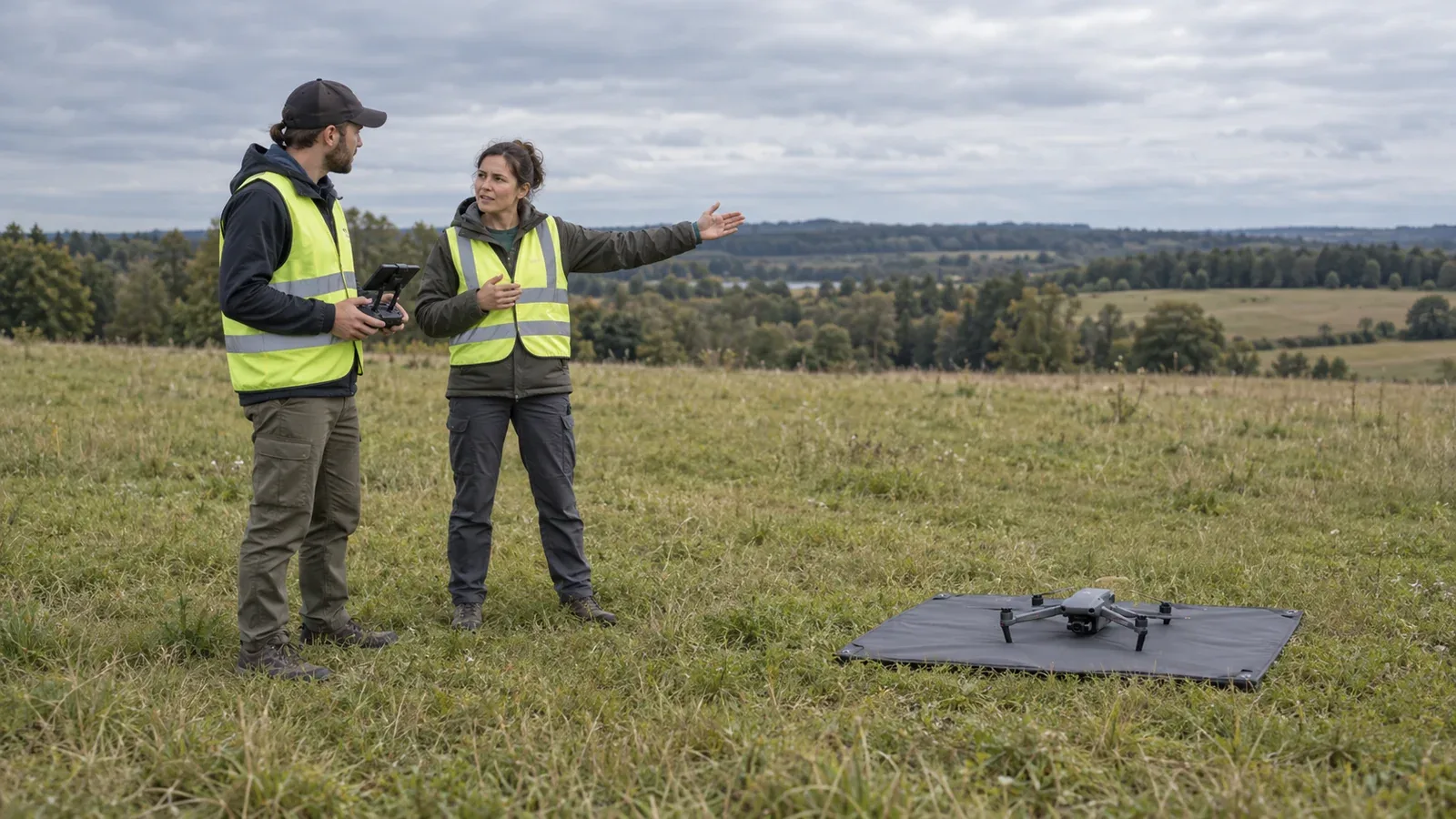
Crew resource management (CRM) means using people, equipment, and information effectively to make safer flight decisions. For a Part 107 drone crew, that means assigning clear jobs, communicating hazards, and keeping anyone from becoming too busy to perform their safety duties. The remote pilot in command remains responsible for the operation even when other people help.
To study Part 107 crew resource management, learn to explain who needs which information, who will act on it, and what changes when a task becomes unmanageable. Memorizing the definition alone will not prepare you to reason through a changing flight situation.
On this page
- What the FAA expects you to understand
- Know who is responsible for each job
- Turn the preflight briefing into usable instructions
- Work through four crew decisions
- Recognize the common traps
- Practice the explanation before the answer
What the FAA expects you to understand
The FAA's Remote Pilot Airman Certification Standards, FAA-S-ACS-10B, list CRM under Operations, Task D: Aeronautical Decision-Making, code UA.V.D.K2. Nearby items cover team communication, task management, situational awareness, hazardous attitudes, and hazard identification. Study these together because a single situation can involve several of them.
Aeronautical decision-making (ADM) is the process of choosing what to do as circumstances change. CRM helps the pilot make that choice using the available resources. Situational awareness means understanding what is happening around the aircraft and how it affects the flight. A correct observation has little value if nobody passes it to the person who must act.
The FAA's Remote Pilot Study Guide directs readers from its short Chapter 6 to Chapter 10 for CRM and judgment. The guide is dated August 2016; use its explanations of human factors alongside current rules. The Part 107 study sequence places these concepts among the other subjects you need to connect.
Resources include a visual observer's warning, a checklist, the aircraft's operating instructions, weather information, and equipment status. Having more information is helpful only when the crew notices what matters and acts in time.
Know who is responsible for each job
The person holding the controller and the remote pilot in command can be different people. Under section 107.19, the remote pilot in command (RPIC) has direct responsibility and final authority for the operation. Giving someone a task does not, by itself, transfer that designation.
The following role comparison summarizes sections 107.12, 107.19, and 107.33, with practical task-allocation guidance from FAA AC 107-2A.
| Role | Main contribution | Boundary to remember |
|---|---|---|
| RPIC | Directs the operation, assesses changing conditions, and makes the operational decision. | Remains responsible when tasks are delegated. |
| Person manipulating the controls | Makes flight-control inputs. This may be the RPIC. | A person without the required certificate or recency may fly only under the applicable direct-supervision provision. |
| Visual observer (VO), if used | Helps track the aircraft and detect collision hazards. | Must coordinate and maintain effective communication with the RPIC and control operator. |
| Other supporting crew | May help with site access, equipment, or information. | Assignments must be specific enough to avoid competing safety duties. |
Section 107.12 permits supervised control manipulation when the RPIC can immediately take direct control. For example, a trainee flying under this provision cannot rely on an RPIC elsewhere who is available only by telephone. Advice over a call does not provide immediate direct control.
A VO is not required for every ordinary Part 107 flight. When one is used, section 107.33 requires effective communication at all times and coordinated scanning and direct visual awareness. Simply naming someone an observer does not make an obstructed route acceptable. The crew must still meet the applicable visual-line-of-sight requirements; a camera feed is not a substitute. A mission that cannot satisfy ordinary visual-line-of-sight requirements needs a different plan or appropriate relief; the BVLOS waiver application guide explains the separate application work.
Turn the preflight briefing into usable instructions
Before flight, section 107.49 requires the RPIC to inform direct participants about operating conditions, emergency and contingency procedures, roles, responsibilities, and potential hazards. A greeting followed by “keep an eye out” does not explain the observer's job.
A useful briefing answers these questions:
- Who is RPIC, who operates the controls, and who watches the aircraft and surrounding hazards?
- What is the flight area, and where can the aircraft land if the intended landing area becomes unavailable?
- How will the crew communicate, and what happens if that method stops working?
- What changes require stopping the work task, landing, or reassessing the plan?
- Who handles visitors or client requests without pulling the observer away from the flight?
- What aircraft-specific action and crew duties apply to an abnormal situation?
This is a suggested briefing structure, not an FAA-prescribed script. AC 107-2A, paragraph 5.3 and Appendix A, explain open communication, suitable communication methods, task allocation, and avoiding overload. They also recommend updating the crew when conditions change.
One practical technique is closed-loop communication: give a clear message, have the receiver acknowledge its meaning, then confirm the resulting action. Agree on shared landmarks or directions before flight. For example, “People entering the west landing pad” identifies a problem; “West pad occupied, using the briefed alternate” confirms that the pilot understood it and selected an action. These are illustrative calls, not standardized FAA phraseology. The alternate must actually be clear and suitable.
Build permission to speak up into the briefing. Anyone should be able to report a hazard or call for the work to stop. That recommended team practice does not remove the RPIC's legal authority; it gets information to the RPIC sooner.
Work through four crew decisions
These are original teaching scenarios, not FAA test questions or accounts of actual flights. The suggested responses apply the cited crew rules and guidance; the flight maneuver still depends on the aircraft and site.
1. The observer becomes the customer liaison
A two-person inspection crew is flying beside a warehouse. The customer asks the VO to review images on a tablet. The RPIC says the aircraft is close, so the VO can do both jobs.
Better response: keep the VO on the assigned observation task. Arrange the image review after landing, or use another suitably briefed person for customer interaction.
Why: the tablet task competes for the same attention the observer needs for aircraft and hazard awareness. “Close” does not resolve that conflict. The CRM failure is task allocation; the team has added work without providing the attention needed to do it. This applies the coordination duties in section 107.33 and the workload guidance in AC 107-2A.
2. A less experienced crewmember challenges the plan
During a preflight discussion, a new crew assistant reports that delivery vehicles are now using the planned recovery area. The experienced RPIC replies that yesterday's arrangement worked.
Better response: verify the report, reassess the recovery area, and brief any change before launch. If the revised setup is not workable, delay the flight.
Why: current conditions matter more than the reporter's seniority. The RPIC still makes the decision, but dismissing the information prevents an informed decision. Section 107.49's environmental assessment and participant briefing supply the legal foundation; the suggested response is an application to this hypothetical site change.
3. The observer's radio stops working
The crew depends on handheld radios because equipment noise prevents normal conversation. During flight, the RPIC hears fragments of a VO's message, then nothing. The aircraft still responds normally to the controller.
Better response: apply the prebriefed communication-loss procedure promptly, stop pursuing the inspection task, and use the briefed safe recovery rather than continue the mission if effective coordination cannot be restored. Do not continue the mission on the assumption that silence means no hazards.
Why: a working aircraft control link and working crew communications are separate things. Section 107.33 requires the latter when a VO is used. Repeatedly troubleshooting a radio while flying the same route does not solve the missing coordination. Before takeoff, the crew should have chosen a fallback that is usable at the actual site.
4. A solo pilot tries to do everything at once
A solo pilot is monitoring an automated mapping flight when a client calls to request a different area. The pilot starts editing mission settings while discussing the request.
Better response: defer the conversation and unnecessary setup changes until the aircraft is safely recovered. Review the changed mission on the ground. If the job requires simultaneous observation, client coordination, and complex payload work, reconsider staffing or simplify the task.
Why: automation is a resource, but it does not supply another person's attention. The FAA study guide describes single-pilot resource management (SRM) as applying resource-management principles to a pilot working alone. Checklists, preparation, and delaying nonessential tasks can reduce competing demands; they do not make an unsuitable solo mission suitable.
Recognize the common traps
Avoid these mistakes when explaining a scenario:
- “CRM means adding a VO.” An extra person helps only when duties, information, and communication fit the operation.
- “The most experienced person should never be challenged.” Experience does not make a new hazard disappear. The RPIC needs timely reports to exercise authority well.
- “Delegating the controls delegates responsibility.” Identify the designated RPIC separately from the person making control inputs.
- “The preflight briefing is enough.” A new hazard, role change, or failed communication method can require a new decision and an updated briefing.
- “Good teamwork permits the flight.” Teamwork does not replace compliance with operating limits or the conditions of an issued waiver.
For each answer option in a practice exercise, ask what it does to the actual problem. Does it restore missing information, reduce conflicting tasks, or preserve clear responsibility? An answer that merely sounds cooperative can leave the unsafe condition unchanged.
Practice the explanation before the answer
Explain a scenario in four sentences: identify the hazard, name the resource or communication gap, choose an action, and say who remains responsible. Then change one condition, such as losing the radio or removing a crewmember, and explain whether your answer still works.
Use the practice-question review method to record why a wrong choice failed. The useful skill is recognizing when the crew's arrangement no longer supports the flight and changing that arrangement before the problem grows.
Sources
- FAA Remote Pilot Airman Certification Standards, FAA-S-ACS-10B: published knowledge scope, particularly Operations Task D.
- FAA Remote Pilot Study Guide, FAA-G-8082-22: Chapter 10 explanations of CRM, decision-making, and single-pilot resource management.
- FAA AC 107-2A: advisory guidance on roles, workload, communication, and visual observation.
- 14 CFR 107.12: certificate requirements and directly supervised control manipulation.
- 14 CFR 107.19: RPIC responsibility and final authority.
- 14 CFR 107.33: coordination and communication when using a visual observer.
- 14 CFR 107.49: preflight assessment and participant briefing duties.
Last checked: September 10, 2026.