
Start your Part 107 study guide with the operating rules, then learn airspace and sectional charts, weather, aircraft loading and performance, and finally the decisions that connect them. Use the FAA's Airman Certification Standards (ACS) as your coverage checklist. Move forward when you can explain a new scenario, rather than when you recognize a familiar answer.
That order is a recommended learning sequence, not an FAA-required schedule. Airspace practice needs altitude vocabulary; weather decisions need operating limits; a useful preflight decision needs all of them. You can shorten familiar topics, but keep every ACS area on your checklist.
In This Guide
- Choose the right certification path
- Build a study kit from FAA resources
- Follow the learning sequence
- Learn rules with their conditions
- Read airspace in three dimensions
- Turn weather reports into decisions
- Connect loading, performance, and operations
- Use practice questions to find unfinished learning
- Make your next study session specific
Choose the right certification path
This sequence is for a first-time applicant preparing for the Unmanned Aircraft General – Small (UAG) knowledge test. The FAA lists 60 questions, two hours, and a 70 percent passing score. Its testing matrix says no instructor endorsement is required to take UAG. Check the current FAA testing matrix before booking.
Passing the test is one step toward a Remote Pilot Certificate. The FAA's certification instructions also cover eligibility, obtaining an FAA Tracking Number, and applying after the test. You must be at least 16 to obtain the certificate. Eligible Part 61 pilots who meet the flight-review requirement have a different initial training route; existing remote pilots maintaining knowledge recency use the appropriate recurrent training. Confirm your route before committing to initial-test preparation.
Build a study kit from FAA resources
Give each resource a job. Keeping several PDFs open without knowing which question each answers makes studying harder.
- Coverage: Remote Pilot ACS, FAA-S-ACS-10B. Use its knowledge elements to track what remains to learn. The FAA ACS listing currently identifies this April 2021 edition as effective April 6, 2021.
- Explanations: Remote Pilot Study Guide, FAA-G-8082-22. Read the relevant chapter when a concept is unfamiliar. Its August 2016 date matters: use current rules for requirements that have changed.
- Figures: FAA computer testing supplements. Select FAA-CT-8080-2H, the supplement covering sport, recreational, remote, and private pilots. The FAA lists the June 2018 edition. Practice finding the requested figure and its legend.
- Question style: FAA UAG sample questions. The August 2021 sample set is representative study material, not a promise of the questions you will receive.
- Current requirements: 14 CFR Part 107, supplemented by the FAA's current operational pages below. Use the regulation to settle what a rule actually requires.
For each difficult topic, write the ACS element, a plain-language explanation, and one example you can solve. Keep a separate column for mistakes. That gives the next study session a starting point more useful than “watch another video.”
Follow the learning sequence
The ACS assigns these test-topic ranges: regulations 15–25 percent, airspace and requirements 15–25 percent, weather 11–16 percent, loading and performance 7–11 percent, and operations 35–45 percent. These are blueprint ranges, not an exact question forecast. Operations deserves substantial attention even though it comes late in this learning sequence. Source: Remote Pilot ACS, Appendix 1.
| Order | Study focus | Why it belongs here | Move on when you can… |
|---|---|---|---|
| 1 | Pilot responsibilities and operating rules | Establishes the conditions later examples must satisfy | Explain the rule, its units, and the condition that changes the answer |
| 2 | Airspace, altitude references, and sectional charts | Connects a location and height to the applicable airspace | Identify the airspace at the aircraft's altitude and justify the authorization decision |
| 3 | Weather reports, forecasts, and hazards | Connects reported conditions to rules and aircraft limits | Decode a report and explain what still needs checking at the site |
| 4 | Loading and performance | Explains how the aircraft's capability changes | Describe the effect of a changed load or environment without inventing a performance number |
| 5 | Airport operations, communications, emergencies, human factors, and maintenance | Brings knowledge together in a flight decision | Explain crew actions and a stop decision in a new scenario |
| 6 | Mixed practice and targeted review | Reveals gaps hidden by topic-by-topic repetition | Solve unfamiliar examples and explain why the alternatives fail |
Topic coverage follows the FAA ACS; the sequence and move-on checks are editorial study recommendations. Use repeated sessions where necessary. Completing one row does not mean finishing that subject permanently.
Learn rules with their conditions
Make paired notes: a requirement on one side and the qualification on the other. For example, under the standard limits in section 107.51, the altitude ceiling is 400 feet above ground level (AGL), with a specific structure exception. Groundspeed is limited to 87 knots, or 100 mph. Flight visibility from the control station must be at least 3 statute miles, with at least 500 feet below clouds and 2,000 feet horizontally from them. Source: Part 107, section 107.51.
Practice the exception: Assume a structure rises 180 feet above level ground. A drone remains within a 400-foot radius of it. The structure provision permits an altitude up to 400 feet above its immediate uppermost limit, giving 180 + 400 = 580 feet AGL in this simplified example. That arithmetic addresses the altitude provision only. A separate authorization limit, cloud clearance, or other applicable restriction can still prevent the flight.
Avoid memorizing “400 feet above takeoff.” Ground level and the takeoff point are not interchangeable when terrain changes. Also keep feet, knots, miles per hour, and statute miles attached to the number you are learning.
Update the topics older materials can miss
Study these together because permission in one area does not settle the others:
- Night: The FAA describes routine night operations without a waiver when the applicable conditions are met, including updated knowledge requirements and anti-collision lighting visible for at least 3 statute miles. Learn the training, equipment, and airspace questions separately. FAA airspace and night guidance.
- Operations over people: Learn Categories 1 through 4 and their different aircraft and operating conditions. A lightweight aircraft alone does not settle eligibility. Category 1 includes a limit of 0.55 pounds including attached equipment, and no exposed rotating parts that would cause lacerations. FAA operations-over-people overview.
- Remote ID: Learn standard Remote ID, broadcast modules, and operations within an FAA-Recognized Identification Area (FRIA). Remote ID concerns identification and location broadcasts; it does not itself grant airspace access. FAA Remote ID guidance.
Create one hypothetical mission and ask three separate questions: what makes the pilot eligible, what makes the aircraft eligible, and what permits this operation here? For operations over people, include the category's restrictions on the actual flight, not just the aircraft's weight. This exposes the common mistake of treating a certificate or an equipment feature as blanket permission.
Read airspace in three dimensions
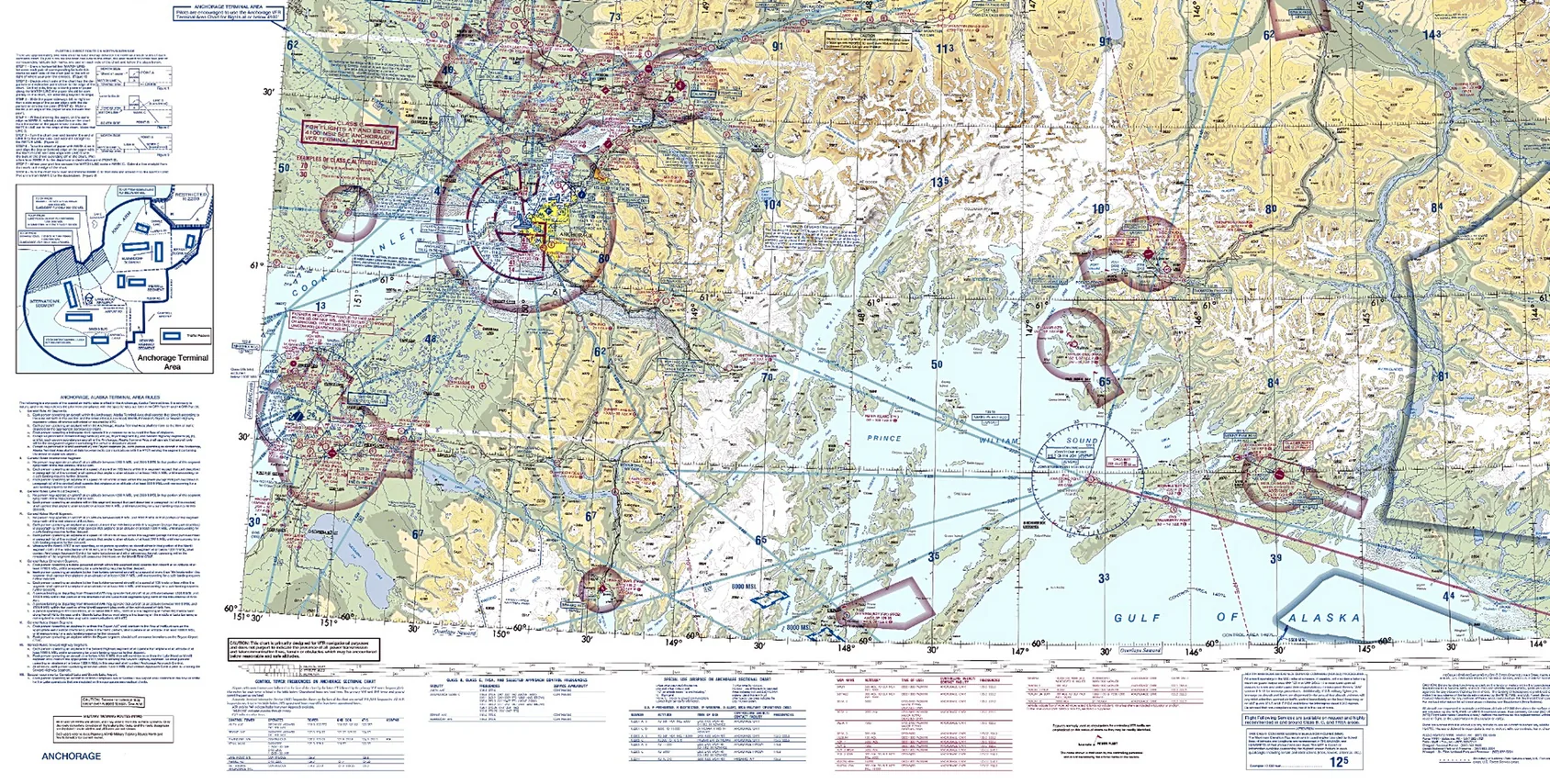
A sectional is an aviation chart showing information such as airspace boundaries, airports, terrain, and obstructions. Start with its legend, then identify the exact position and altitude in the problem. The FAA Aeronautical Chart Users' Guide is the reference for chart symbols; the edition listed when checked is effective July 9, 2026.
Learn the distinction between AGL, measured above the local ground, and MSL, referenced to mean sea level. Airspace can begin at the surface or at an elevated floor. The FAA's AIM airspace descriptions explain these vertical structures. A boundary drawn around your location does not, by itself, establish the airspace at your proposed flight height.
Worked altitude example: Assume level terrain at 1,200 feet MSL. The aircraft is 300 feet AGL, so its altitude is 1,200 + 300 = 1,500 feet MSL. A hypothetical overlying shelf starts at 2,000 feet MSL. The aircraft is 500 feet below that shelf. You still need to identify the underlying airspace; being below the shelf is not enough to call the location unrestricted.
For an authorization question, apply section 107.41 to the actual airspace. It requires prior ATC authorization in Class B, C, or D airspace and within the lateral boundaries of an airport's designated Class E surface area. Source: Part 107. “Near an airport” and “inside airspace requiring authorization” are different questions. Learn airport traffic considerations alongside the boundary rules.
Practice in this order: find the figure, locate the position, read the legend, identify the vertical limits, convert altitude references if necessary, then decide which rule applies. Keep the chart evidence visible in your explanation. On a second attempt, change the aircraft's altitude and see whether the answer changes.
The featured Anchorage chart is a historical illustration of sectional-chart detail, not the chart for the hypothetical shelf example. Use the FAA testing supplement for referenced exam figures and current aviation information for flight planning.
Turn weather reports into decisions
A METAR reports observed aviation weather; a TAF forecasts conditions for an airport over a stated period. First learn the time and location, then wind, visibility, weather, and cloud groups. The Aviation Weather Center's product guide explains the codes.
Consider this invented practice excerpt: 18012G20KT 5SM BKN020. It describes wind from
180 degrees true at 12 knots, gusting to 20 knots; 5 statute miles visibility; and a
broken cloud layer with a base 2,000 feet above station level. The figures are teaching
inputs, not a current weather report.
Now connect the decoding to a decision. Assume, solely for the calculation, that the same cloud base exists over level terrain at the flight site. An aircraft at 300 feet AGL would be 2,000 − 300 = 1,700 feet below it. That addresses vertical separation only. Horizontal cloud distance, local flight visibility, actual site weather, and the aircraft's wind limits remain separate checks.
The trap: A nearby airport's report does not prove the conditions at your control station. Likewise, a decoded wind group does not tell you whether your aircraft can handle the gusts. Practice stating both what the report tells you and what it cannot establish.
Next, study fronts, stability, fog, thunderstorms, wind shear, and density altitude. For explanations beyond a code lookup, use the FAA's current Aviation Weather Handbook, FAA-H-8083-28B. Match each topic to a decision: what would make you delay, change the operating area, or stop?
Connect loading, performance, and operations
Density altitude expresses air density as an equivalent altitude in the standard atmosphere. Higher density altitude means thinner air and reduced aerodynamic performance. High temperature, high elevation, and low pressure can contribute; humidity also matters. Extra weight increases the demand on the aircraft, and load placement affects balance. The FAA Remote Pilot Study Guide explains these relationships.
Worked reasoning example: Compare the same aircraft on a cool morning with its planned afternoon flight carrying additional equipment in hotter conditions. You can identify reasons to reassess performance and balance. You cannot calculate a new endurance or climb rate from those facts alone. The missing inputs are the aircraft's applicable performance information and the actual loading and environmental conditions.
For operations study, rotate through short scenarios instead of making a single stack of definitions:
- An arriving aircraft changes the traffic situation: explain how you will give way and keep the landing area available.
- A visual observer identifies a hazard: explain the communication and immediate crew response.
- A control link is lost: explain which aircraft-specific settings and recovery behavior should have been checked before launch.
- A pilot is fatigued or under pressure to finish: identify what needs to change before the flight continues.
- An inspection finds a damaged component: explain why a successful power-on check does not resolve that finding.
Use the ACS operations tasks to check coverage of radio procedures, airports, emergencies, aeronautical decision-making, physiology, and maintenance. The study guide supplies background explanations. Your scenario answer should name the action and its reason, then identify any aircraft-specific information needed. Do not assume every aircraft handles a failure the same way.
Use practice questions to find unfinished learning
Begin with the official FAA samples after your first pass through the subjects. Use the referenced supplement figures. For every answer, explain the rule or concept before looking at the key. The sample PDF includes ACS codes, which let you return to the knowledge element behind a mistake. FAA UAG sample questions.
Classify each error in a short notebook:
| Error | What to do next |
|---|---|
| You did not know the concept | Read its explanation and create a fresh example |
| You knew the rule but missed a condition | Rewrite the note with the exception or limiting condition |
| You misread a chart or unit | Repeat the figure lookup and write the units beside each input |
| You answered a different question | Restate the exact question before solving it |
| You remembered the answer but could not explain it | Change the scenario and solve again without the answer choices |
This is a suggested review method, not an FAA scoring system. Recheck missed topics in a later session. Then mix subjects so that a heading no longer tells you which rule to apply.
For timed practice, use the published two-hour UAG limit. Do not make “I once scored 70 percent” your only readiness test. A stronger personal check is whether unfamiliar figures and changed assumptions still produce a reasoned answer. If you can finish a quiz quickly because you remember its wording, switch to explaining the answers and changing the examples. No practice score or fixed number of study days guarantees the official result.
Make your next study session specific
Open the ACS and mark the areas you can already explain. Start the sequence at the first gap, work one example with the FAA reference open, then try a changed example without it. End by recording the next unresolved question.
When mixed practice reveals a weakness, return to that subject rather than restarting every resource. Before booking, confirm the current test requirements and your certification route. You are ready to make that decision when your preparation demonstrates understanding across the full subject list, including operations, instead of familiarity with a small set of answers.
Sources
- FAA Airman Knowledge Testing Matrix: UAG question count, allotted time, passing score, and endorsement requirement.
- FAA: Become a Certificated Remote Pilot: initial certification, eligibility, and alternate training paths.
- FAA Remote Pilot ACS, FAA-S-ACS-10B: tested knowledge elements and topic-weight ranges.
- FAA ACS listing: current listed Remote Pilot ACS edition and effective date.
- FAA Remote Pilot Study Guide: explanatory background on performance and operational topics; dated August 2016.
- FAA computer testing supplements: listed FAA-CT-8080-2H figure supplement and edition.
- FAA UAG sample questions: representative question style, figure use, and ACS coding.
- 14 CFR Part 107: regulatory operating limits and airspace-authorization requirements.
- FAA Part 107 airspace authorizations: authorization pathways and night-operation conditions.
- FAA operations-over-people overview: categories and aircraft conditions.
- FAA Remote ID guidance: broadcast identification and compliance pathways.
- FAA Aeronautical Chart Users' Guide: chart-reference purpose and current listed edition.
- FAA AIM: Controlled Airspace: airspace classes and vertical structure.
- NOAA Aviation Weather Center: Product Info: METAR and TAF interpretation and weather-code units.
- FAA Aviation Weather Handbook, FAA-H-8083-28B: current handbook for further weather study.
Last checked: September 6, 2026.