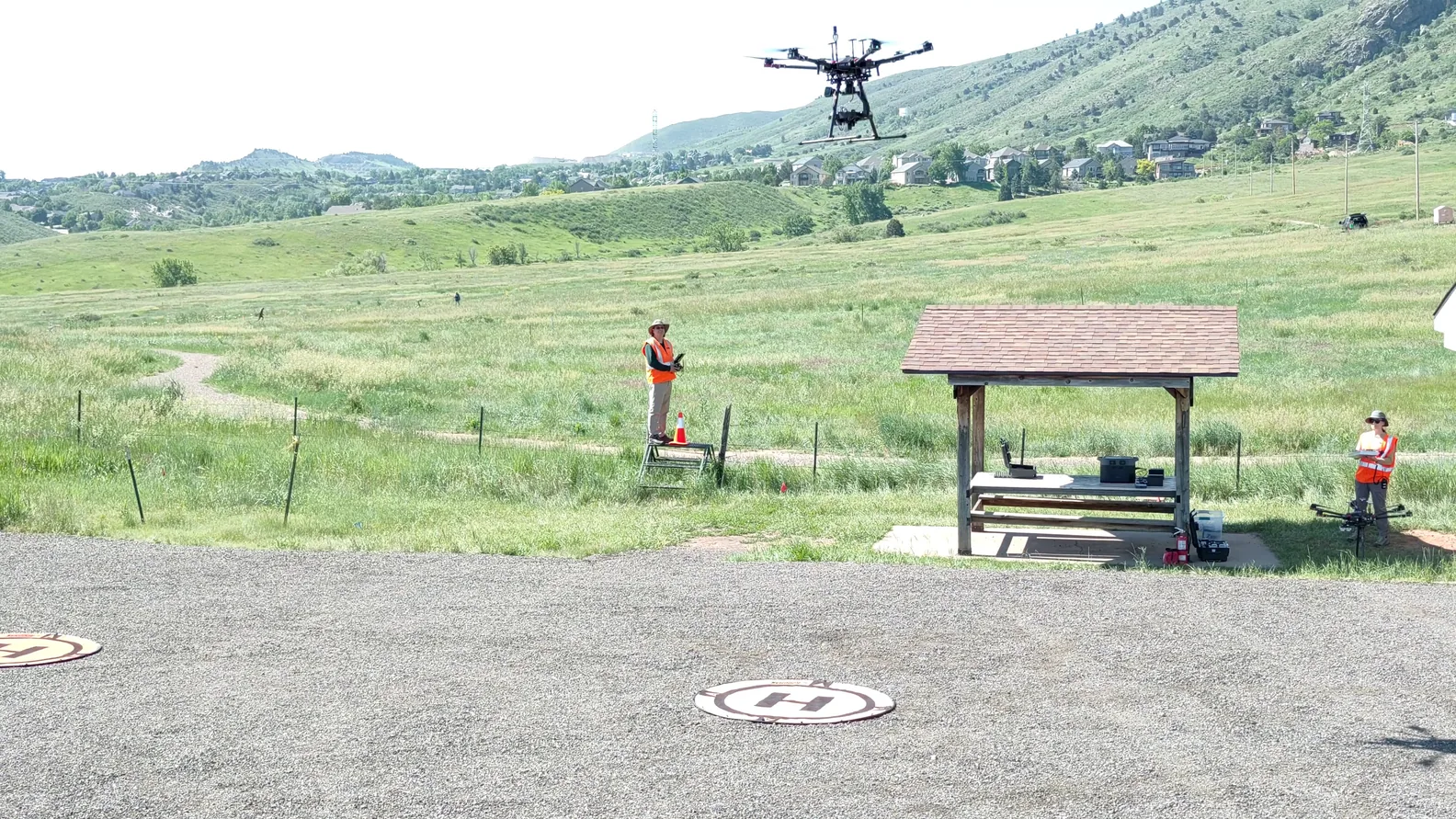
Part 107 visual line of sight means keeping the drone close enough to see its position and movement directly, assess nearby air traffic, and recognize hazards to people or property. A camera feed cannot replace that capability. Under 14 CFR § 107.31, the remote pilot, control operator, and any visual observer must retain the required visual capability throughout the flight. An FAA waiver can authorize a specific deviation.
For a planned job, first check whether the entire route remains visible from the crew's operating positions. If it does not, change the route or crew positioning, divide the work into separate flights, or obtain the necessary waiver before flying.
On This Page
- What the federal rule requires
- Distance and visual limits
- Observers, FPV, and brief glances
- Exceptions and waiver applications
- Documentation
- Checking rule changes
What the federal rule actually requires
Section 107.31 has two parts that must be read together. Paragraph (a) requires the remote pilot in command, anyone else manipulating the controls, and any visual observer to be able to see the aircraft without vision aids other than corrective lenses. Paragraph (b) allows either the pilot and control operator, or a visual observer, to exercise that capability throughout the flight.
Seeing a speck is insufficient if you cannot judge where the aircraft is, its orientation, height and travel direction, surrounding traffic, or danger to people and property. Those are the functions specified in the VLOS regulation.
This article covers U.S. civil small-drone flights under Part 107, whose small-aircraft definition requires a takeoff weight below 55 pounds, including everything attached. Flights qualifying for the separate limited recreational exception follow a different legal route. Owning a Remote Pilot Certificate does not grant blanket permission for beyond-visual-line-of-sight, or BVLOS, operations.
There is no universal distance you may fly
Section 107.31 sets a visual-performance requirement, not a fixed radius in feet or miles. The separate minimum flight visibility of 3 statute miles in § 107.51(c) describes atmospheric visibility from the control station. It does not authorize flying a small drone three miles away. See the Part 107 operating limitations.
Aircraft size, contrast against the background, glare, terrain, and obstructions can change the useful operating area. A clear radio connection says nothing about whether the crew can still perform its visual duties. The FAA's VLOS safety discussion also stresses the need to see approaching aircraft, including low-flying helicopters. A drone visible against a building does not mean the airspace behind that building is adequately observable.
Decisions at the edge of the visible area
| Situation | What it means for the flight | Practical response |
|---|---|---|
| The drone is visible, but its orientation is no longer discernible | Required visual information is missing | Bring the operating boundary closer. |
| A roof or tree line hides part of the planned route | The route contains a visual obstruction | Change the route or plan separate flights from suitable positions. |
| The pilot can see the drone, but surrounding terrain conceals approaching aircraft | Collision detection may be compromised | Reassess the site and the available view of the airspace. |
| The controller shows a strong signal after visual contact is lost | Telemetry does not restore direct observation | Use the briefed loss-of-sight procedure. |
These are editorial applications of § 107.31, the FAA's VLOS safety discussion, and AC 107-2A, section 5.9. They are planning examples, not distance allowances or automatic waivers.
Visual observers, FPV goggles, and brief glances
A visual observer is optional for ordinary compliant operations. If used, § 107.33 requires effective communication among the observer, remote pilot, and control operator. They must coordinate airspace scanning and direct visual awareness of the drone. The pilot must ensure the observer can meet § 107.31.
Brief the observer on where the aircraft will fly, how to identify a hazard, and which call requires an immediate response. A practical exercise is to have the observer report an approaching aircraft and confirm that the pilot understands the direction and intended action. That exercise is a suggested crew practice, not a prescribed FAA script.
For first-person-view goggles, the FAA's Part 107 summary calls for an observer to keep the drone in unaided sight. The pilot must still retain the required visual capability. An observer farther along a route does not automatically authorize the pilot to fly beyond what the pilot can see. The waiver guidance specifically discusses observer relays and possible waivers of observer requirements.
AC 107-2A explains that brief controller checks and airspace scans are compatible with VLOS. It provides no permissible number of seconds for losing sight. Regain visual contact as soon as practicable; if that fails, use predetermined contingency procedures appropriate to the aircraft and site. Hovering, landing, or return-to-home may be appropriate in different circumstances. Choose the response before launch, accounting for obstacles and people along any automated return path.
The same guidance says binoculars may briefly assist situational awareness but cannot maintain the required VLOS. At night, a strobe and telemetry alone are insufficient to establish compliance. A light's rated visibility is not your permitted operating radius.
Exceptions and the current FAA waiver process
Under Part 107, Subpart E, the FAA may waive § 107.31 when a proposed operation can be conducted safely under specified conditions. The certificate covers only the deviations it actually authorizes. A VLOS waiver cannot be issued under § 107.205(c) to carry someone else's property by aircraft for compensation or hire. This restriction concerns that transportation activity; it does not prohibit all paid drone work.
An in-flight emergency requiring immediate action is separate: § 107.21 permits deviation only as necessary to meet that emergency. The FAA may request a written report. It is not advance permission for a planned hidden flight segment. Controlled-airspace authorization under § 107.41 is another separate requirement; it does not itself waive § 107.31. Both provisions appear in Part 107.
For a new operational waiver application, follow the current FAA Part 107 Waivers page:
- Identify each rule the proposed operation cannot meet, including observer requirements where applicable.
- Describe the operation and address the relevant safety-explanation questions.
- Submit through the Aviation Safety Hub, linked from that FAA page.
- Respond to FAA requests for information and wait for a decision before conducting the proposed deviation.
The FAA says previously submitted waivers continue in DroneZone; airspace-authorization applications also remain there until further notice. Its stated waiver-review goal is 90 days, with timing dependent on complexity and application completeness. That is not a guaranteed approval date. Read requests promptly: the FAA says a failure to respond within 30 days results in cancellation.
Explain how safety will be maintained without ordinary VLOS
The FAA's Waiver Safety Explanation Guidelines ask how the pilot will know aircraft position, contain the operation, detect and avoid traffic, and handle failures. Address the actual route, command-link limits, weather, lost-link behavior, personnel training, and any detection system's demonstrated capability. Include how return-to-home avoids obstacles and people. Describe evidence relevant to the proposed environment; a manufacturer's maximum radio range alone does not answer these questions.
What to document before flying
Sections 107.31 and 107.33 do not prescribe a dedicated VLOS flight-log form. Section 107.49 does require the preflight environment assessment and briefing of participants. Section 107.7 requires the remote pilot's certificate and identification to be readily accessible and relevant required records to be available for inspection. These duties are in Part 107.
A useful crew record includes the operating boundary, pilot and observer positions, known blind spots, communication method, and loss-of-sight response. Record changes when glare, obstructions, or crew positioning alter that plan. This is a recommended operating practice, not a claim that every ordinary VLOS flight requires that particular record.
For waived operations, use the issued certificate and its conditions as the controlling checklist. Preserve whatever training, operational, or other records those conditions require. A waiver issued to another operator is useful background, not permission for your flight. Subpart E requires compliance with the certificate's limits.
Check changes before committing to a BVLOS job
The FAA's proposed BVLOS rulemaking, commonly discussed as Part 108, included a reopened comment period in January 2026. A proposal does not itself authorize a flight. The eCFR reviewed for this article still contains § 107.31 and the Part 107 waiver provisions. Before relying on a future pathway, verify the final rule, effective date, applicability, and transition terms.
For the next job, draw the flight boundary from what the crew can actually observe. If the route cannot fit that boundary, redesign it or resolve the applicable FAA approval first. Build the operating plan around that decision before promising a BVLOS service to a client.
Sources
- 14 CFR § 107.31. Federal VLOS capability and observation requirements.
- 14 CFR Part 107. Federal applicability, visibility, emergency, airspace, preflight, and inspection provisions.
- FAA: There's More to VLOS Than Meets the Eye. Safety guidance on airspace observation and obstructions.
- FAA AC 107-2A, section 5.9. Advisory guidance on brief interruptions, visual aids, observers, and night visibility.
- 14 CFR § 107.33. Federal observer communication and coordination duties.
- FAA: Small UAS Regulations, Part 107. Official summary, including FPV observer guidance.
- FAA Waiver Safety Explanation Guidelines. Application guidance for VLOS and observer deviations.
- 14 CFR Part 107, Subpart E. Federal waiver authority, conditions, and limitations.
- FAA: Part 107 Waivers. Current application service, transition instructions, and response timelines.
- DOT: BVLOS rulemaking comment-period reopening. Official proposed-rulemaking notice.
Last checked: September 7, 2026. The eCFR displayed Title 14 current through September 3, 2026. Recheck regulatory changes, the FAA application service, guidance revisions, and individual waiver conditions before relying on this process.