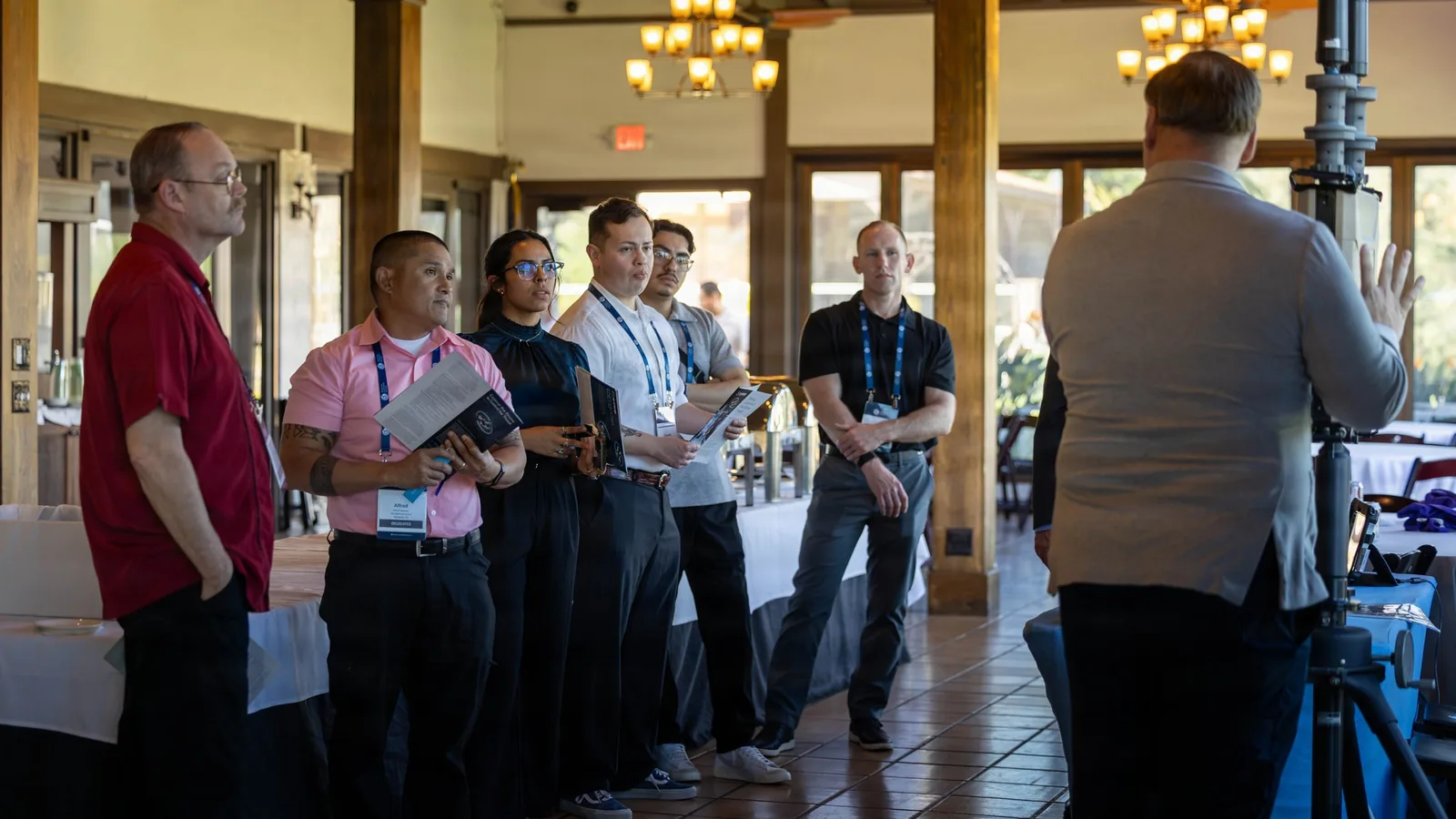
Start with a decision, not an event name
An event is a delivery format. Professional development is the change in capability that
should follow. Separating those ideas prevents a common failure: selecting a familiar
conference first and inventing a business reason later.
Define one primary outcome before looking at a program. Useful outcome statements
include:
- Compare three detect-and-avoid approaches against an approved set of operational
requirements.
- Learn a mapping workflow well enough to run a supervised field trial.
- Understand a proposed rule or standard well enough to brief the program's accountable
executive.
- Meet public-safety program managers who have deployed a similar concept of operations.
- Find research partners working on a defined perception, navigation, assurance, or
human-factors problem.
- Build an implementation plan for a platform the organization has already selected.
Keep secondary benefits, such as broad awareness or morale, separate. They can matter,
but they do not rescue an event with no primary outcome.
Apply hard gates before scoring
A high-quality agenda is irrelevant if the attendee cannot enter the room or the desired
session is excluded from the purchased pass. Reject or pause an event when any required
gate fails:
- Eligibility: The attendee meets professional, government, invitation,
citizenship, security, or membership requirements.
- Access: The exact pass includes the intended workshops, technical sessions,
exhibition, demonstrations, and recordings.
- Feasibility: Dates, travel, workload, accessibility needs, and any equipment or
software prerequisites can be met.
- Authority: Participation is not being mistaken for regulatory approval, operating
authority, procurement approval, or permission to deploy a technology.
- Credit acceptance: If continuing-education credit is essential, the receiving
employer, licensing board, certification body, or other authority has confirmed what
it will accept.
When a gate is uncertain, ask the organizer or receiving body in writing. Save the
answer with the registration record.
Match the event type to the work
No format is universally best. A large exhibition offers breadth and comparison. A small
workshop can offer practice and feedback. A standards meeting can influence work that
will matter for years, even though it may offer little product discovery.
| Event type | Best use | Evidence to look for | Usually a poor fit when |
|---|
| Trade show or industry expo | Compare products, suppliers, integrations, and market approaches | Exhibitor list, demonstration conditions, buyer-oriented sessions, access to technical staff | The goal is deep neutral instruction or peer-reviewed research |
| Technical or academic conference | Study methods, results, limitations, and emerging research | Reviewed papers, technical committees, tutorials, proceedings, data or methods in abstracts | The immediate need is hands-on product selection or basic operator training |
| Regulatory or policy symposium | Interpret policy direction, hear regulator and operator perspectives, prepare comments or strategy | Confirmed agency roles, precise policy topics, public materials, clear discussion rules | The goal is flight proficiency or a vendor-neutral product comparison |
| Standards or working-group meeting | Contribute to requirements, test methods, terminology, safety, and interoperability | Published scope, participation rules, ballots or work items, minutes, committee continuity | The attendee only wants a broad industry overview |
| Workshop or short course | Build a bounded skill with instruction, practice, and feedback | Prerequisites, learning outcomes, instructor qualifications, exercises, assessment, materials | The description promises inspiration but no observable learning outcome |
| User or manufacturer conference | Improve implementation inside a selected ecosystem and learn product roadmaps | Technical labs, administrator tracks, customer case details, access to product specialists | The organization still needs a neutral comparison among competing platforms |
| Vertical-industry event | Connect unmanned systems to a mission such as surveying, energy, agriculture, emergency response, or infrastructure | Domain practitioners, workflow integration, applicable data standards, end-user case evidence | The attendee needs broad unmanned-systems market coverage |
| Local association meeting or meetup | Build regional relationships and solve local operating problems at low travel cost | Relevant agencies, employers, educators, operators, and recurring peer contact | A national policy or highly specialized research question is the main objective |
Official programs show why these distinctions matter. The
Commercial UAV Expo schedule separates
session formats and access levels, and it identifies exhibitor showcase presentations as
vendor presentations. That can be excellent for product discovery, but it is different
from a neutral technical comparison.
XPONENTIAL spans multiple autonomous-system
domains and combines conference and exhibition formats, making it a possible breadth
choice when the attendee has a disciplined plan.
For research, the
IEEE Robotics and Automation Society's ICRA series
combines technical papers, workshops, tutorials, competitions, and exhibits. Paper
review should not be projected onto every sponsor session or floor presentation. For
standards work, ASTM Committee F38 is a different
proposition: ongoing committee participation around unmanned-aircraft standards, not
passive conference consumption.
Even events from the same professional association may serve different outcomes. A
policy-focused attendee might examine the
AUVSI Drone and AAM Policy Symposium,
while someone seeking broad technology exposure might examine XPONENTIAL. A manufacturer
event such as Skydio Ascend can be useful for
implementation and peer learning within that ecosystem, but it is not a substitute for
neutral supplier comparison. These are examples of types, not endorsements or rankings.
Programs, access, and dates change, so verify the current event page before acting.
Commercial breadth versus defense and public-safety focus
A commercial event can be efficient when a buyer needs broad exposure to aircraft,
sensors, software, services, and end-user workflows. Defense and public-safety events
may put more weight on acquisition, mission integration, trusted technology, interagency
work, after-action learning, or restricted discussion. The narrower audience can improve
relevance while adding eligibility, information-sharing, security, procurement, and
travel constraints.
The current AUVSI Defense description, for
example, centers military capability, acquisition, procurement, manufacturing, and
multi-domain integration. The
DRONERESPONDERS Public Safety Summit
is aimed at first-responder program managers and remote pilots and emphasizes agency
experience and peer exchange. Those examples do not establish who will attend a future
session. Verify the current agenda, confirmed roles, attendance eligibility, discussion
rules, and what can be carried back to the employer.
Specialized counter-UAS, defense, or public-safety participation does not itself grant
operating authority, procurement approval, access to restricted information, or
permission to deploy a technology. Keep professional learning separate from the legal,
technical, and organizational approvals required for the actual mission.
Decide who should attend and who should not
The strongest candidate is not always the most senior person or the most enthusiastic
pilot. It is the person positioned to acquire the needed information, judge it, and
transfer it into work.
| Candidate | Attend when | Do not send when |
|---|
| Operator or remote pilot | Sessions address a defined mission, risk, procedure, aircraft, or skill gap and include usable practice or practitioner evidence | Attendance is being treated as a substitute for aircraft-specific proficiency or required FAA recency |
| Program manager | The event supports a documented technology, policy, staffing, vendor, or governance decision | There is no decision calendar, internal sponsor, or ability to act on what is learned |
| Engineer or researcher | Technical depth, methods, data, authors, or collaborators align with an active problem | The program offers only broad market summaries or sales demonstrations |
| Public-safety or government professional | Eligibility is confirmed and the agenda includes relevant agencies, after-action learning, procurement, policy, or interagency practice | Restricted discussions cannot be used or shared in the attendee's role, or procurement rules make the planned activity inappropriate |
| Founder or business-development lead | Named buyers, partners, users, or investors fit a specific market hypothesis and meetings can be arranged | “Visibility” is the only goal and no target-account or follow-up plan exists |
| Student or early-career professional | The event provides accessible technical sessions, mentors, employers, student rates, competitions, or portfolio-building work | Travel consumes the development budget but the attendee lacks prerequisites or access to the valuable sessions |
| Instructor or training lead | The goal is curriculum currency, instructor development, standards awareness, or employer-needs research | Conference attendance will be advertised as an academic or professional credential it does not award |
| Procurement or legal specialist | Contract, data, security, supply-chain, regulatory, or acquisition questions are central to an active decision | The exhibit floor is being used to bypass required diligence or approved procurement channels |
For a team, send the smallest group that covers distinct roles. Two attendees with a
shared itinerary often duplicate sessions and conversations. Two attendees with separate
technical and program tracks can return with complementary evidence. Record who owns
each question before travel.
People should usually skip the event when the same outcome can be met by current
proceedings, a recorded briefing, a local workshop, a supplier demonstration, or a
focused call. They should also skip when the organizer will not clarify access, when the
relevant speakers are merely invited, or when no one inside the organization owns the
post-event decision.
Read the agenda as evidence
An agenda title is a promise, not proof. Read the full session description and test it
against the outcome. Strong descriptions usually identify the audience, the operational
problem, what will be examined, who has relevant experience, and what the attendee can
use afterward.
Evaluate each priority session
Give a prospective session one point for each “yes” answer:
- Does it name a concrete question, task, system, rule, method, or decision?
- Does it identify the intended audience and any prerequisite knowledge?
- Does the speaker have directly relevant operating, research, regulatory, standards,
instructional, or implementation experience?
- Does the description promise methods, data, constraints, failure modes, or lessons,
rather than only trends and opportunity?
- Is the commercial role of the speaker or session clear?
- Is there time for questions, practice, discussion, or access to supporting material?
- Does the purchased pass include the session?
A low score does not prove a poor session, but it signals uncertainty. Ask for a fuller
description or lower the value assigned to it. Build the case for attendance from three
to five priority sessions, not from the total number of agenda entries.
Vendor-led content can be useful. A product specialist may explain configuration,
integration, troubleshooting, or roadmap detail better than a neutral speaker. The
problem begins when promotional content is scored as independent evaluation.
For every vendor-led session, label its intended use:
- Discovery: learn what a product claims to do and what questions to investigate.
- Implementation: improve work with a platform already selected through an approved
process.
- Comparison input: collect evidence that must be checked against requirements,
demonstrations, references, contracts, security review, and competing options.
- Relationship: reach the technical or support people needed for an existing
deployment.
Do not count a polished case study as proof that the result will transfer to another
mission. Look for operating context, baseline, measurement method, constraints,
exceptions, and the user's role in the presentation.
Evaluate speakers, participants, and networking access
Networking value comes from relevant access, not crowd size. Start with a short list of
people or role types connected to the objective: end users with similar missions,
regulators responsible for the issue, standards contributors, researchers using a needed
method, integration partners, or technical staff from shortlisted suppliers.
Translate a broad networking promise into the relationship the event must support:
- Recruiting: meet candidates, hiring managers, educators, or workforce partners for
defined roles and skills.
- Supplier: reach technical and commercial contacts who can answer a documented
requirement, integration, support, or procurement question.
- Customer: arrange conversations with qualified users or buyers whose mission fits
a specific offering and who have agreed to discuss it.
- Investor: confirm that relevant investors attend and that scheduled access exists;
logo placement or general visibility is not a financing strategy.
- Partnership: identify the capability gap, the contribution expected from each
party, and the next decision a meeting could advance.
Check speaker evidence beyond the title line:
- Is the biography specific about the work related to this session?
- Is the person presenting direct experience, research, policy responsibility, or a
secondhand market summary?
- Are affiliations and commercial interests visible?
- Are promised officials confirmed, or only invited?
- Can attendees ask questions or meet the speaker, or is the format one-way?
Then inspect the access design. Hosted meetings, working groups, small workshops,
receptions, appointment tools, and moderated roundtables create different opportunities.
Some restricted or off-the-record discussions may improve candor but reduce what can be
quoted, recorded, or transferred. Confirm the discussion rule before promising a report
that depends on attributable statements.
Set a modest networking plan: five priority contacts, a reason to speak with each, and a
useful question. Schedule important meetings before arrival. After each conversation,
record the context, permission for follow-up, and one next action. A stack of badge
scans is not a relationship pipeline.
Calculate loaded cost and likely return
Registration price is only one line. Compare events using loaded cost:
Loaded cost = registration and add-ons + travel and lodging + local expenses +
employee time + work coverage + preparation and follow-up.
| Cost or return item | What to capture |
|---|
| Registration | Base pass, workshops, certifications or exams, association membership required for the rate, and taxes or fees |
| Travel | Air or ground transport, baggage or equipment, lodging, meals, local transportation, travel days, and change risk |
| Staff time | Event hours, travel hours, preparation, internal coverage, and follow-up work |
| Access risk | Sessions behind a higher pass, invitation-only rooms, capacity limits, schedule conflicts, and unavailable recordings |
| Expected output | Decision brief, comparison, skill demonstration, contact plan, standards contribution, curriculum update, or proposed procedure |
| Avoided cost or created value | Faster decision, reduced rework, resolved technical risk, qualified partner, improved method, or prevented unnecessary purchase |
Do not force a speculative revenue number. Use the most defensible output. A procurement
team may value a requirements-based comparison. An operator may owe a demonstrated
workflow. A researcher may return with a collaboration plan and three relevant papers.
If no observable output justifies the loaded cost, choose a narrower option.
Virtual access can reduce travel but may also remove demonstrations, private meetings,
or informal peer contact. Recordings can increase knowledge transfer, but only if the
needed sessions are recorded and the license permits internal use. Treat format as a
tradeoff, not as an automatic discount.
Verify professional-development and credit claims
Words such as “credit,” “certificate,” “certified,” and “accredited” are not
interchangeable. Ask what is awarded, who issues it, how participation is verified, and
who accepts it.
The
Institute for Credentialing Excellence
distinguishes an attendance or participation certificate from an assessment-based
certificate and from personnel certification. Attendance documents presence.
Assessment-based programs connect instruction to an assessment. Personnel certification
assesses broader competence against a scheme and is not simply a document handed out
after a class.
The
IACET explanation of the CEU
defines one continuing education unit as ten contact hours in an organized continuing
education experience under responsible sponsorship, capable direction, and qualified
instruction. An organizer's use of “CEU” does not by itself answer whether a specific
employer or credential accepts it. IACET likewise tells learners to
confirm recognition with the receiving organization
before enrolling.
Use this verification list:
- What exact item appears on the record: contact hours, attendance certificate,
assessment result, certificate, badge, or certification?
- Which sessions qualify, and how many verified instructional hours do they contain?
- Are learning outcomes stated, and is mastery assessed?
- Who issues the record, and is a transcript or durable verification available?
- Has the receiving employer, licensing board, certification body, or agency confirmed
acceptance in writing?
- Does the claim expire or require renewal, experience, an examination, or another
condition?
- Is the organizer describing preparation for an examination as though it were the
credential itself?
For remote pilots, conference attendance does not replace FAA aeronautical-knowledge
recency. The FAA's
Remote Pilot Certificate process
identifies the accepted initial and recurrent paths and the 24-calendar-month recency
requirement. See our
Part 107 Remote Pilot Certificate guide for
the current workflow. Keep regulatory recency, employer development, platform
proficiency, and third-party credentials as separate records. Operational teams can use
our
Part 107 flight-log and records guide
to distinguish regulatory records from additional evidence retained by policy.
Score the surviving options on 100 points
Score only events that pass every required gate. Rate each factor from 0 to 5, multiply
the rating by the listed weight, and divide by 5. The result is a maximum of 100 points.
| Factor | Weight | A 0 means | A 5 means |
|---|
| Mission fit | 25 | No defined connection to the required outcome | Direct support for a time-bound decision, skill, relationship, or deliverable |
| Agenda and evidence quality | 20 | Vague themes, unclear formats, or promotion presented as education | Several accessible sessions with precise questions, qualified speakers, methods, constraints, and usable material |
| Relevant people and access | 15 | Desired participants are absent, unconfirmed, or unreachable | Confirmed participants and formats support purposeful conversations |
| Loaded cost and time | 15 | Cost is unknown or disproportionate to likely value | Full cost is known and efficient relative to the expected output |
| Format, pass, and logistics | 10 | Critical access or feasibility remains uncertain | The pass, schedule, format, accessibility, and travel plan are confirmed |
| Credit or development validity | 10 | Claims are vague or not accepted where needed | The learning design and record are clear, and required acceptance is confirmed |
| Transfer plan | 5 | Learning depends on memory and individual initiative | A named owner, artifact, audience, due date, and follow-up action are approved |
For example, a mission-fit rating of 4 contributes 20 points: 4 divided by 5, multiplied
by the 25-point weight. Record a short reason beside every rating. Unsupported precision
is a warning sign, so resolve major unknowns rather than awarding optimistic points.
As a working policy, not an industry standard, an organization might shortlist events at
75 points or above, require a written exception from 60 through 74, and decline those
below 60. Adjust thresholds after comparing predicted value with actual post-event
results. A niche standards meeting might deserve approval with a modest score if it is
the only place to complete a critical work item; document that exception instead of
manipulating the ratings.
Copyable event scorecard
- Outcome due within 30 days:
- Attendee and role:
- Hard gates passed, with evidence:
- Three to five priority sessions:
- Five priority people or role types:
- Loaded cost:
- Weighted score and rationale:
- Post-event artifact, owner, audience, and due date:
- Approval decision and approver:
Use the same scorecard for an expensive national conference, a one-day standards
meeting, and a virtual workshop. Consistent questions make unlike formats comparable
without pretending they are identical.
Build employer approval around transfer
Employer-funded attendance is easier to judge when the request resembles a small work
plan rather than a travel wish list.
Before approval
The employee should submit the outcome statement, gate evidence, scorecard, loaded cost,
priority agenda, coverage plan, and promised artifact. The manager should confirm that
the outcome matters now, that the attendee can act on it, and that a less costly method
would not meet the need.
For vendor evaluation, include requirements and procurement constraints before the
exhibit visit. For a technical workshop, name the environment in which the new skill
will be demonstrated. For policy or standards work, identify the internal decision or
document that the event will inform.
During the event
Protect the priority sessions before adding optional ones. Capture decisions, evidence,
limitations, source links, and follow-up actions instead of transcribing every slide.
Keep promotional claims labeled. Respect session rules, confidential information, export
controls, photography limits, and off-the-record discussions.
After the event
Deliver the promised artifact while the evidence and contacts are fresh. Good outputs
include:
- A requirements-based vendor comparison with unresolved diligence questions.
- A technical brief that separates demonstrated results from claims.
- A supervised skill demonstration and proposed practice plan.
- A policy or standards memo with affected procedures and decision dates.
- A curriculum update tied to current authority and learning outcomes.
- A contact plan with owners, consented follow-ups, and next actions.
Hold a short review 30 to 60 days later. Ask whether the artifact was used, a decision
improved, a risk resolved, a skill demonstrated, or a relationship advanced. Feed that
result into future scores for the organizer and event type. The goal is not to prove
that every trip succeeded. It is to make the next allocation better.
Use the conference selection checklist
Before registering
- Write one primary outcome and due date.
- Confirm attendee eligibility and any invitation or security requirement.
- Confirm the exact pass, workshop add-ons, capacity limits, prerequisites, and
recording access.
- Select three to five priority sessions and evaluate their descriptions and speakers.
- Identify five priority contacts or role types and request important meetings.
- Separate neutral education, research, practitioner evidence, and vendor promotion.
- Verify any credit or certificate with both the issuer and receiving body.
- Calculate loaded cost, including time, coverage, preparation, and follow-up.
- Name the post-event artifact, owner, audience, and delivery date.
- Apply the hard gates and complete the weighted score.
During the event
- Follow the priority itinerary and record why any substitution was made.
- Capture evidence, assumptions, constraints, source material, and open questions.
- Label vendor claims and note what independent verification is still needed.
- Record contact context, permission to follow up, owner, and next action.
- Preserve attendance or assessment evidence without overstating what it proves.
After returning
- Deliver the promised artifact and source links.
- Brief only the teams that can use the information.
- Convert useful findings into a decision, trial, procedure, curriculum change, or
assigned follow-up.
- Store credit records according to the receiving organization's requirements.
- Review actual value after 30 to 60 days and update future selection assumptions.
Frequently asked questions
Can I evaluate an event before the full agenda is published?
You can screen the event, but do not invent value for sessions that have not been
described. Assess the durable event scope, intended audience, access model, prior
program quality, and loaded cost. Mark agenda fit and speaker access as unknown, then
set a date to recheck before any internal approval or purchase deadline. A preliminary
theme is not enough for a final score.
Treat those as different decisions. Attendance buys access for learning, evaluation, or
relationships. Exhibiting and sponsorship buy a commercial presence or benefits defined
by the organizer. Create a separate objective, owner, cost model, target audience, and
success measure for each. A useful attendee program does not automatically justify a
sponsorship, and payment does not turn promotional exposure into editorial authority.
How far in advance should a team evaluate an event?
Start when enough program, speaker, pass, and cost information exists to test the hard
gates. For travel events, that is often before discounted registration or refundable
travel deadlines, but do not approve from a preliminary agenda. Recheck speakers,
session access, and logistics before the cancellation deadline and again shortly before
travel.