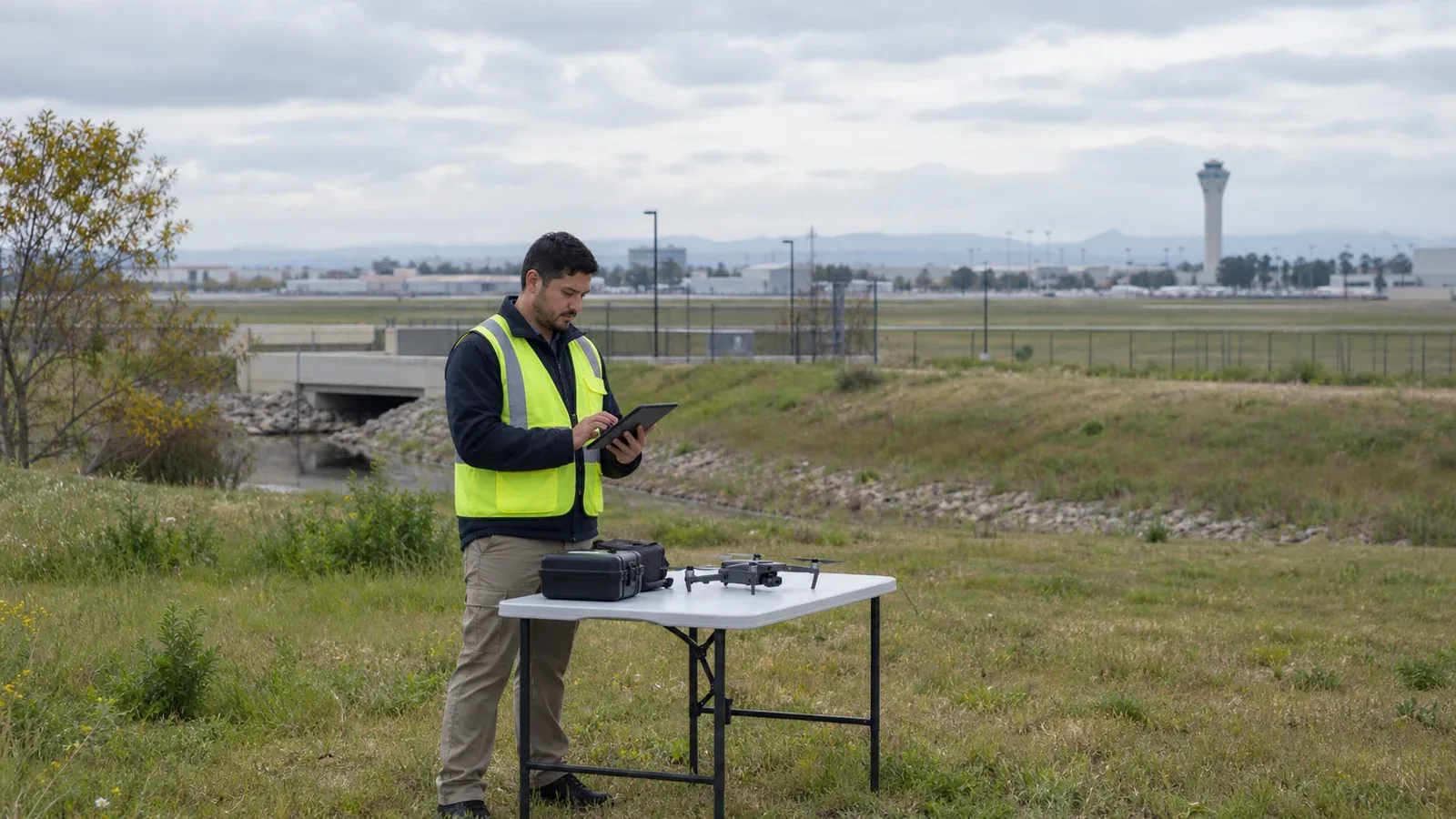
A zero-foot LAANC grid can still have an application path for a Part 107 pilot. A flight above that grid value needs further coordination, which sends the request for FAA review instead of automatic approval. The FAA explicitly includes zero-foot grids in this process. A submitted request, however, gives you no permission to launch. FAA Part 107 airspace authorizations
Start by confirming three things: the actual flight area, whether its airport supports LAANC, and whether your service provider supports Part 107 further coordination. Then prepare the requested height, operating window, and site-specific explanation. This guide focuses on that above-grid exception, rather than the routine LAANC application.
On This Page
- What the zero means
- Choose an application route that fits
- Prepare an operation a reviewer can understand
- Allow review time and handle the result
- Check the authorization against the actual flight
What the zero means
A UAS Facility Map divides airport surroundings into cells with altitude values. Those numbers identify heights at which the FAA may authorize operations without additional safety analysis. The map itself grants no authorization, including in a cell with a positive number. FAA UAS Facility Maps
In a zero-foot cell, any proposed positive flight height exceeds the displayed value. That changes the review needed; it does not establish that every application must be denied. Moving a launch pin into an adjacent higher-value cell does not solve the problem if the aircraft's route still enters the zero-foot area.
The values are feet above ground level (AGL), not height above a roof or elevation above sea level. Treat a building inspection's requested height accordingly. The FAA's facility-map FAQ explains both the height reference and the additional coordination for above-grid requests.
The legal prerequisite comes from 14 CFR § 107.41: Part 107 operations need prior ATC authorization in Class B, C, or D airspace and within the airport-designated surface area of Class E. A small aircraft, short flight, property owner's permission, or low roofline does not replace that authorization.
Choose an application route that fits
LAANC means Low Altitude Authorization and Notification Capability. Its further-coordination route is available to Part 107 pilots, not recreational operations under the recreational exception. The FAA describes requests above the map ceiling up to 400 feet AGL; this is not a route to exceed that height. FAA LAANC eligibility
Use these questions to separate an unsupported app function from an operation needing a different FAA process:
| Your situation | Next step |
|---|---|
| Part 107 flight in a zero-foot cell at a LAANC-enabled facility | Check for further coordination in a supported provider, using the complete flight footprint. |
| App offers ordinary LAANC but no above-grid request | Check the FAA supplier table's further-coordination column and the provider's current instructions. |
| Airport does not offer LAANC | Use the FAA's manual DroneZone authorization process. |
| Operation is on airport property | Use DroneZone and address airport-sponsor access requirements. |
| Operation needs both a waiver and airspace authorization | Apply for both through DroneZone, following the applicable instructions. |
| Recreational operation needs a positive altitude in a zero-foot cell | This Part 107 further-coordination route does not apply. Change the plan or establish the applicable authorization path before flying. |
These distinctions follow the FAA's LAANC guidance. An app's inability to accept a request is a reason to investigate eligibility and submission options, not evidence of approval or a universal ban.
On-airport work has a separate route. The FAA says LAANC cannot be used to request authorization for on-airport operations; those requests go through DroneZone. Airport sponsors also control access to operate from their property. A zero-foot cell near an airport and a job on airport property are therefore different application situations. FAA on-airport operating guidance
Supported provider workflows
The FAA's current supplier table lists both Aloft and Airspace Link as supporting Part 107 further coordination. Check the capability column, not simply whether a company appears on the LAANC list.
In Aloft Air Control, prepare the operation and airspace request with the actual location, height, and time. Its detailed guide describes the above-ceiling process and a safety-justification step. Explain the proposed operation using real conditions and resources; do not copy claims about training, crew, or equipment that you cannot substantiate.
Airspace Link's AirHub Portal compliance guide also supports further-coordination submission. Its Variable Height option adjusts requests to map ceilings for automatic authorization. That feature does not obtain a positive-altitude exception in a zero-foot cell. Similarly, an internal manager's approval in the portal is separate from FAA airspace authorization.
Interfaces and account permissions can change. If the option is absent, ask provider support to clarify the operation's eligibility and the correct workflow before changing the application solely to make it submit.
Prepare an operation a reviewer can understand
Further coordination involves an Air Traffic Manager's decision. Under the FAA's LAANC facility procedures, an operator may supply a one-way safety justification to assist review. This is optional under the FAA procedure, although a provider may make it a submission step. It is not a waiver application or advance negotiation with the tower.
The following is a practical preparation worksheet, not an FAA-prescribed form:
| Prepare | Make it specific |
|---|---|
| Flight footprint | Identify the entire route and working area, including the zero-foot portion, rather than only the takeoff address. |
| Height | State the maximum AGL height needed; distinguish it from clearance above the object being photographed. |
| Schedule | Give dates, start and end times, time zone, and realistic operating duration. |
| People and contact | Identify the responsible person and remote pilot as requested; use a contact number that will work during the operation. |
| Task and equipment | Explain what the aircraft will do and the actual aircraft and crew resources available. |
| Flight boundaries and contingencies | Explain how the operation will stay within its area and height, and how the crew will respond if it cannot. |
Use this sheet to catch contradictions before entering the request. A short inspection described as covering an entire neighborhood leaves the reviewer uncertain about what is actually proposed. A tightly drawn boundary is useful only if the complete intended flight fits inside it.
For example, consider a hypothetical roof inspection on a flat site in a zero-foot cell. The operator proposes a maximum of 80 feet AGL during a defined morning window. Neither that number nor the presence of the building establishes acceptable airspace risk. The useful application explains where the aircraft will operate, why that height is needed, where the pilot will stand, and the planned recovery area.
Before submitting that scenario, check:
- Does the outlined area include the inspection passes and intended recovery route?
- Is 80 feet measured from the ground, and does the flight plan actually stay within it?
- Do the times use the intended local time zone, including the correct date?
- Does the description match the crew and equipment that will be on site?
- Can the job be postponed if authorization is absent or its conditions cannot be met?
This example is a way to prepare consistent inputs, not wording that secures approval. Do not describe flight beside a building as automatically shielded from airport traffic.
Allow review time and handle the result
The FAA says further-coordination requests must arrive at least 72 hours before the proposed start and may be submitted up to 90 days ahead. Its authorization page supplies those submission limits. They do not promise a decision within 72 hours.
Aloft's guide still states 48 hours; use the FAA's 72-hour requirement and check the current submission screen. Airspace Link's guide also specifies 72 hours. Do not plan around another pilot's reported turnaround time.
The FAA facility procedure says unanswered further-coordination requests expire three hours before the proposed start. A pending, expired, denied, or canceled request is not an authorization. If denied, read any reason supplied and submit a revised request only after addressing it. Facilities do not directly process these requests with operators, so calling the tower is not a shortcut. Follow any contact instructions in an issued authorization. FAA further-coordination procedures
If LAANC is unavailable, the FAA's manual route is DroneZone. Its Part 107 instructions direct applicants to choose Airspace Authorization, enter the operation and responsible-party details, and retain the application reference number. The FAA asks for manual requests at least 60 days ahead; this is planning guidance, not a guaranteed completion date. Follow current portal routing if it directs a LAANC-eligible request elsewhere.
Check the authorization against the actual flight
When approval arrives, compare its area, maximum height, dates, operating window, and conditions with the job you intend to perform. For the hypothetical inspection, an approval that does not cover the necessary route or time cannot support the original plan. Revise the job to fit the authorization or obtain the needed authorization before proceeding.
Keep a usable copy with the operation record, including any special conditions and subsequent changes. Recheck its status before launch: the FAA can suspend or cancel an authorization as circumstances change. The facility-map FAQ explains why valid contact details matter when the FAA needs to reach an operator.
LAANC addresses airspace permission only. Weather, NOTAMs, other airspace restrictions, and the remaining operating requirements still need separate checks. An authorization does not turn an otherwise unsuitable flight into an acceptable one. FAA LAANC guidance
Your final decision should be straightforward: the actual operation is covered by an effective authorization and its conditions, or it waits. A zero-foot grid starts a review question. Only an issued authorization that fits the flight resolves the airspace-permission question.
Sources
- FAA UAS Data Exchange: LAANC: eligibility, supplier capability table, and application routing.
- FAA Part 107 Airspace Authorizations: zero-foot requests, submission lead times, and DroneZone fields.
- FAA UAS Facility Maps: grid meaning and the distinction from authorization.
- FAA Facility Map FAQ: AGL heights, additional coordination, and cancellation.
- 14 CFR § 107.41: prior ATC authorization requirement.
- FAA facility procedures, Chapter 12 Section 9: manual review, justification, expiry, and facility responsibilities.
- Aloft Air Control detailed guide: provider workflow; its timing statement differs from FAA guidance.
- Airspace Link AirHub Portal compliance guide: further coordination and the limits of internal approval and variable-height requests.
- FAA on-airport operations: DroneZone routing and airport-sponsor access authority.
Last checked: September 9, 2026. Recheck current FAA instructions, provider capabilities, and the airspace conditions for each operation.