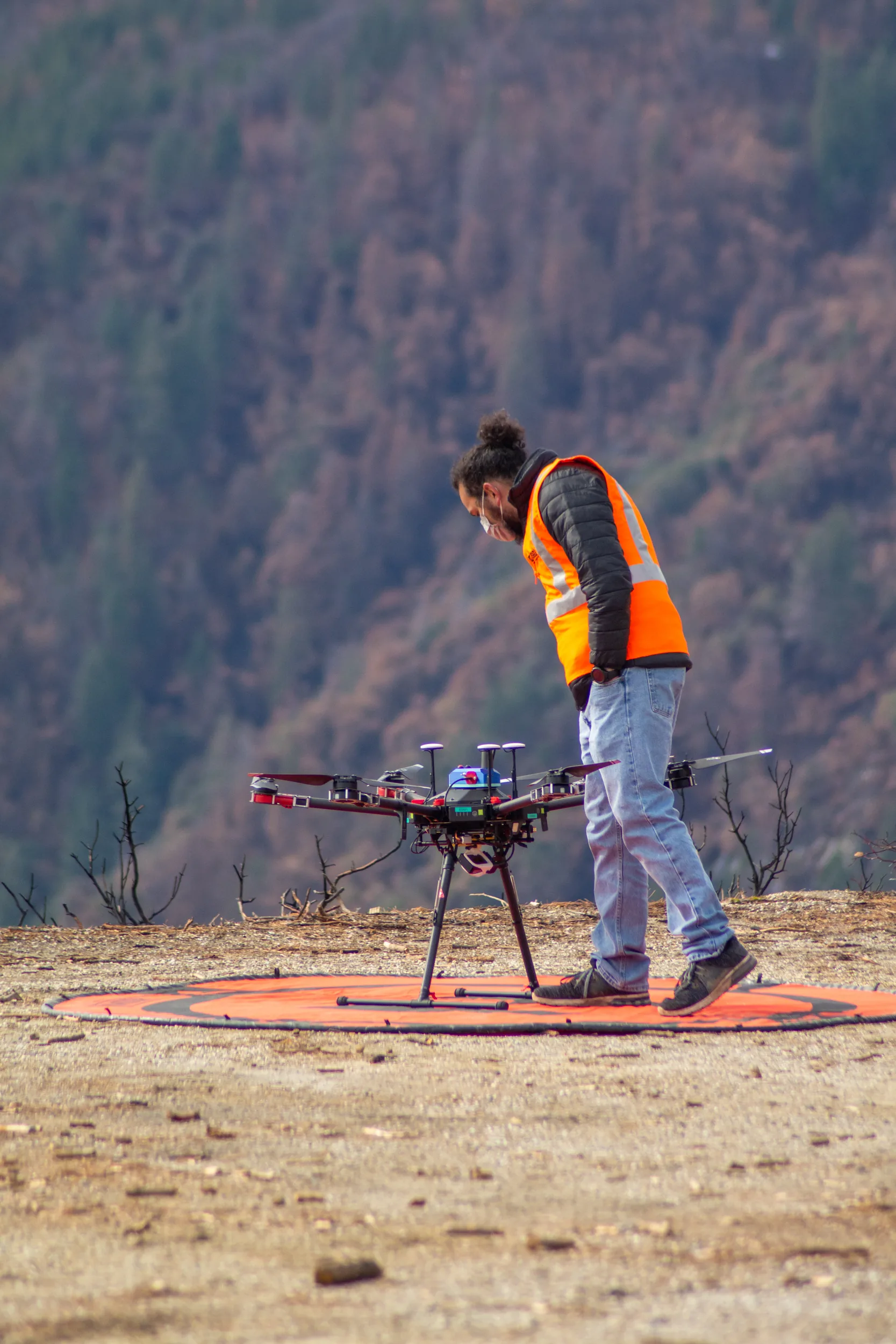
A commercial drone preflight checklist should confirm that the pilot, flight permissions, site, aircraft, and crew are ready for the same planned operation. Work through those checks before arming, resolve every safety-critical discrepancy, and make an explicit go/no-go decision. Repeat the aircraft safety check before each flight, including after a battery change.
This checklist is for ordinary U.S. civil small-drone work under Part 107. Adapt the equipment steps to the manufacturer's instructions and add any conditions imposed by your authorization, waiver, or operating procedures. The remote pilot in command (RPIC) makes the final flight decision.
On This Page
- Complete the prerequisites before traveling
- Use this checklist at the launch site
- Check the limits that can stop the flight
- Turn equipment checks into specific decisions
- Keep a useful preflight record
- Recheck changes before the next launch
Complete the prerequisites before traveling
Assign the RPIC and confirm the job fits the intended operating authority. Part 107 applies to small aircraft weighing less than 55 pounds at takeoff, including attachments and payload. Under 14 CFR Part 107, § 107.15 requires a safe-condition check before each flight; § 107.49 requires assessment, briefing, working control links, sufficient power, and secure loads. A checked box cannot replace those duties. Use the drone risk assessment template to record the hazards, verified controls, and remaining risk behind the go/no-go decision.
Prepare these items before loading the vehicle:
- Pilot documents: Remote Pilot Certificate, required identification, and evidence of current aeronautical knowledge. Confirm the applicable initial-test or training path and the 24-calendar-month recency requirement using the FAA's pilot certification and recurrent-training guidance. Put the actual completion date in the job file.
- Aircraft registration: Check the assigned aircraft's registration, external marking, and accessible paper or digital certificate. The recreational weight exception does not exempt a sub-250-gram aircraft used under Part 107. See the FAA's registration requirements.
- Airspace permission: Obtain any required approval for the actual operating area, height, and time. The FAA's airspace authorization instructions explain LAANC and DroneZone. A submitted request or facility-map grid value is not permission to launch.
- Site and mission arrangements: Confirm access to the operating location, the customer's scope, crew availability, and the aircraft-specific checklist. Resolve required permissions and any waiver conditions before accepting the day's launch plan.
Use the drone site survey to check the planned operating area, obstacles, and recovery locations before completing the field checklist.
For practical use, keep the job documents available offline. A phone with no service should not be the first time you discover that the authorization was only bookmarked.
Use this checklist at the launch site
Use the table as a read-and-confirm sequence. Record pass, hold, or not applicable beside each row; explain every not-applicable decision. The order and hold prompts below are suggested operating practice, drawing on § 107.49 and the FAA's AC 107-2A, Appendix E. They are not an FAA-issued approval form.
| Check | Confirm before launch | Hold the flight when |
|---|---|---|
| Pilot and crew | Named RPIC; fitness for duty; roles, hazards, emergency actions, and communication briefed | Illness, fatigue, distraction, or unclear responsibility compromises safety |
| Airspace | Current restrictions reviewed; authorization matches the location, altitude, and time | Required permission is missing or the proposed flight exceeds it |
| Weather | Actual site conditions and forecast fit regulatory, aircraft, and operator limits | Conditions exceed a limit or the planned route cannot remain safe |
| Ground area | People, traffic, wires, obstacles, launch area, and alternate landing area assessed | The intended separation or recovery area cannot be maintained |
| Aircraft | Airframe, propulsion, attachments, and applicable control surfaces inspected | Damage, looseness, or an unresolved maintenance discrepancy remains |
| Power and payload | Aircraft and controller power checked; intended load secure; duration and recovery allowance planned | Available power is insufficient or the load affects controllability |
| Control and navigation | Correct aircraft connected; controls, indications, and applicable navigation checks satisfactory | A warning or unexpected indication remains unexplained |
| Remote ID | Applicable compliance path confirmed; required equipment functioning | Required broadcasting is unavailable |
| Final release | Area clear; crew ready; RPIC states go or no-go | Any earlier hold remains unresolved |
Source basis: Part 107, AC 107-2A, FAA airspace guidance, and Part 89 linked in this article; checked September 8, 2026. The hold column is an editorial aid for applying those sources to a job.
Check the limits that can stop the flight
Weather and the planned flight path
Without an applicable waiver, § 107.51 requires at least 3 statute miles of flight visibility from the control station and cloud separation of 500 feet below and 2,000 feet horizontally. The usual ceiling is 400 feet above ground, with a defined structure exception. A lower authorization ceiling still controls the authorized operation. Ordinary Part 107 operations also require visual line of sight under § 107.31.
Write the controlling altitude beside the mission, rather than relying on a default app setting. Assess the actual launch site as well as a weather report. For aircraft wind, temperature, precipitation, and navigation limits, use the exact manual and configuration; there is no suitable universal wind-speed or satellite-count value for this checklist.
Restrictions and special operating conditions
Recheck the FAA's airspace restrictions resources for temporary flight restrictions, security restrictions, stadium restrictions, and nearby emergency activity. A prior authorization does not remove a newly applicable restriction. Note when the check was made and revisit it after a significant delay.
For night work, confirm the pilot's qualifying updated knowledge test or training and anti-collision lighting visible for at least three statute miles with an adequate flash rate. For flight over people or moving vehicles, establish the applicable aircraft eligibility and operating conditions before choosing that route. The FAA's operations-over-people and night overview explains these separate conditions. Having a customer on site does not make every bystander a flight participant.
Remote ID readiness
Identify whether the flight uses Standard Remote ID, a broadcast module, or another permitted path. Compare the relevant serial number with the registration information and follow the manufacturer's functional checks. The FAA's Remote ID guidance explains the compliance options and registration updates.
Under Part 89, Subpart B, a broadcast module must be functioning before takeoff. Required broadcasts continue from takeoff to shutdown. If Standard Remote ID or a module stops broadcasting in flight, land as soon as practicable. Module operations also require the person manipulating the controls to see the aircraft throughout the flight. Treat a Remote ID failure separately from a healthy control link or camera feed.
Turn equipment checks into specific decisions
Use the manufacturer's inspection sequence for the actual aircraft. AC 107-2A recommends inspecting the entire system and correcting servicing or maintenance issues before operating. Check propellers and their attachments, batteries and latches, payload mounts, controller indications, and any installed safety equipment. Calibrate only as required by the applicable instructions.
For your own checklist, replace vague labels such as “battery good” with the decision you need to make. Identify the installed battery, its condition, the intended flight duration, and the recovery allowance selected for the job. Likewise, “navigation good” should identify the checks appropriate to that aircraft, rather than assume that a map pin proves every navigation function is ready.
Review return-to-home and lost-link behavior, where fitted, against the current launch point and surrounding obstacles using the aircraft's instructions. Check the recorded home point and any return altitude against the route and authorized ceiling. A stored setting belongs to a previous configuration until you have checked its suitability for this one. If a discrepancy cannot be explained and corrected using the relevant procedure, keep the aircraft grounded.
Brief a concrete response to interruptions: who calls out approaching aircraft, who monitors the ground area, what the pilot does if communication is lost, and where the aircraft can land if the main landing area becomes unavailable. Ask crew members to repeat their assigned actions so an ambiguous instruction is discovered before takeoff.
Keep a useful preflight record
The general preflight duties in §§ 107.15 and 107.49 do not prescribe a universal signed checklist or routine flight-log format. Separate those duties from recommended documentation. Specific waivers, authorizations, Category 4 operations, employer procedures, or contracts may impose additional records or retention conditions.
Keep the Remote Pilot Certificate and required identification in physical possession and readily accessible when exercising certificate privileges. Carry the aircraft registration certificate in paper or digital form, and have applicable authorization and waiver documents available as their conditions require. A useful additional job record can contain:
- Job reference, location, date, time zone, and planned flight window.
- RPIC and crew names, aircraft identifier, battery identifiers, and payload configuration.
- Authorization reference, geographic boundary, altitude limit, and special conditions.
- Weather and restriction-check time, site hazards, and chosen mitigations.
- Checklist result, discrepancies found, corrective action, and the person completing it.
- Final go/no-go decision, actual launch time, and any reason for cancellation.
This is a suggested record structure, not a claim that every field is federally mandatory. Tie the entry to a particular flight so “passed this morning” cannot be mistaken for “checked this aircraft in its present condition.” A no-go entry is useful too: record the unresolved issue and what must change before reconsideration.
Recheck changes before the next launch
A battery swap begins another flight, so repeat the safe-condition check and reassess what has changed. As a practical checklist habit, also revisit affected items after moving the launch point, changing the payload, receiving a warning, changing crew, or waiting through a weather or airspace change.
For example, in a hypothetical inspection job, a delivery truck parks in the alternate landing area while the pilot changes batteries. The fresh battery does not resolve the blocked recovery area. Reassess the site, choose a usable alternative, and update the crew briefing before releasing the next flight.
Use one checklist for each aircraft configuration, with the job-specific limits beside it. Launch only after the RPIC has resolved the holds and can explain why the current aircraft, crew, and site support the intended flight.
Sources
- 14 CFR Part 107: regulatory text covering preflight duties, pilot responsibilities, and operating limits.
- FAA remote-pilot certification guidance: certificate and recurrent-training paths.
- FAA drone registration guidance: registration, markings, and certificate possession.
- FAA Part 107 airspace authorizations: LAANC and DroneZone approval processes.
- FAA AC 107-2A: advisory guidance, including Chapter 7 inspections and Appendix E's sample checklist.
- FAA airspace restrictions: restriction types and official resources for location checks.
- FAA operations over people overview: conditions for people, moving vehicles, and night operations.
- FAA Remote ID guidance: compliance paths and registration details.
- 14 CFR Part 89, Subpart B: Remote ID functional checks, broadcasting, and failure response.
Last checked: September 8, 2026.