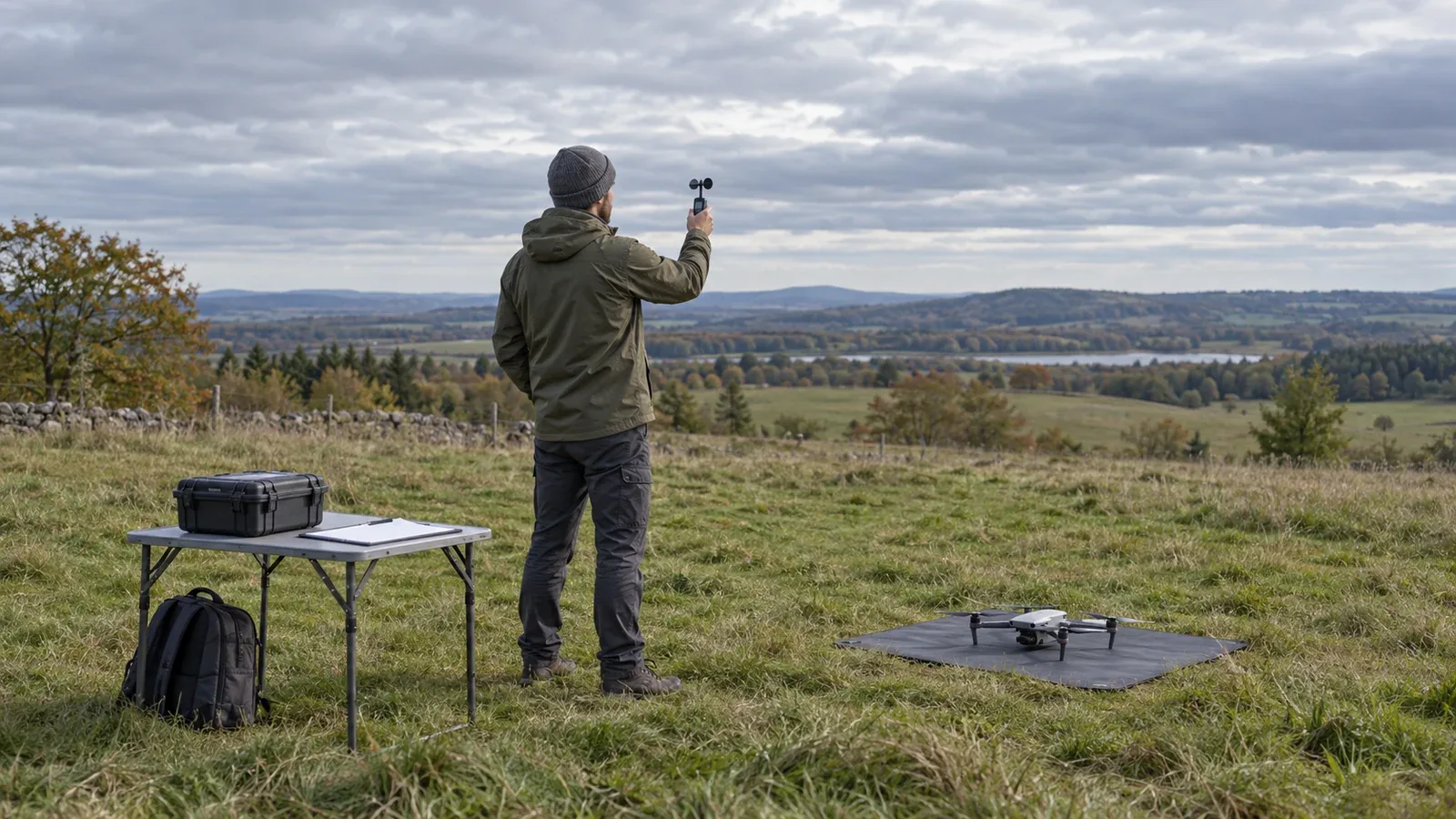
For ordinary U.S. Part 107 operations, drone weather minimums are 3 statute miles of flight visibility from the control station, with the aircraft at least 500 feet below clouds and 2,000 feet horizontally from clouds. Personal limits add a margin for your aircraft, current proficiency, location, and recovery options. Meeting the weather numbers alone does not establish that a flight is safe.
Before accepting a launch, compare the expected conditions through landing against the applicable rules, the aircraft documentation, and your written operating limits. If any one fails, postpone or change the mission and assess it again.
On This Page
- Separate the three kinds of limits
- Bring the weather report to the launch site
- Set personal limits before the job
- Make the launch and landing decisions
- Keep a useful weather decision record
Separate the three kinds of limits
The following distinctions prevent an app's green flight indicator from becoming the whole decision. Regulatory values come from 14 CFR Part 107, particularly § 107.51; the personal-limit column is recommended operating practice.
| Limit | What controls it | What to establish before launch |
|---|---|---|
| Visibility and cloud separation | Part 107, or the specific terms of an applicable FAA waiver | Required visibility and both cloud distances throughout the flight |
| Aircraft operating conditions | Documentation for the actual aircraft, battery, payload, and configuration | Wind, temperature, precipitation, and other restrictions that apply to this setup |
| Personal and program limits | Your proficiency and the operator's written procedures | A more conservative launch boundary and an earlier landing trigger |
Part 107 does not supply one universal maximum wind speed or rain allowance. If the aircraft instructions do not establish suitability for expected precipitation, do not assume that light rain is acceptable. The remote pilot in command, or RPIC, must assess local weather and brief participants under § 107.49. A system must be in safe operating condition under § 107.15. Airspace permission does not waive weather requirements; an applicable waiver must expressly cover the rule being varied.
Flight visibility describes the distance at which suitable reference objects can be identified. It is different from keeping a small aircraft visibly oriented nearby. Review the Part 107 visual line of sight rules when haze, glare, background contrast, or the proposed route makes aircraft observation difficult.
Cloud clearance is not just a ceiling number
A reported ceiling describes certain cloud layers or obscuration. Individual scattered clouds still matter to aircraft separation. A weather display marked VFR is not a drone launch authorization.
Consider a hypothetical flat site with a reliably established cloud base 800 feet above the local ground. A proposed flight at 300 feet above that same ground leaves 500 feet below the cloud: 800 − 300 = 500 feet. That meets only the vertical number, with no extra margin. Horizontal cloud distance, local visibility, other operating limits, and changes in cloud height still need separate decisions.
Do not transfer an airport's cloud height to different terrain without checking the height reference and actual local conditions. The FAA Aeronautical Information Manual weather section explains cloud reporting and weather-product interpretation. If uncertainty in the cloud-base estimate could consume the separation margin, delay until you can establish adequate clearance. Lowering the flight height helps only if the revised route remains safe and useful.
Bring the weather report to the launch site
Have three inputs ready: current weather observations and forecasts, the relevant aircraft instructions, and a site plan showing the flight area and recovery locations. A drone site survey helps identify terrain and structures that make the airport report less representative.
A METAR reports observed airport weather; a TAF forecasts conditions around its airport for a stated period. Read the observation time, forecast validity, station location, wind and gusts, visibility, clouds, and significant weather. The Aviation Weather Center product guide explains these fields. A fresh download can still contain an older observation.
For example, the illustrative wind group 22012G20KT means wind from 220 degrees true
at 12 knots, gusting to 20 knots. Compare the gust value with your gust limit, using
matching units. Do not compare the sustained value in knots with an aircraft figure in
miles per hour.
Use forecasts to assess the whole operating window, including landing and packing up. Check temporary deterioration and approaching hazards, then compare the forecast with what the crew actually sees. If that operating window extends into darkness, include the Part 107 night-operations guide in the preflight review.
The FAA's AC 107-2A, section 5.12.3 recommends the nearest reporting station that best represents the surrounding terrain. If suitable reports are unavailable, the pilot needs another reliable way to determine visibility and cloud clearance before operating.
At the site, identify known-distance landmarks, look for low cloud or fog moving into the route, and assess wind in exposed areas. A handheld measurement beside a sheltered vehicle describes that position; it cannot establish wind throughout the flight volume. AC 107-2A Appendix B explains how buildings, trees, terrain, and atmospheric conditions affect airflow and aircraft performance.
If local observations conflict with the report, resolve the difference before launch. Record the uncertain condition and what would establish it, such as a newer representative observation or a reliably assessed change at the site. Repeatedly refreshing a favorable airport reading does not resolve fog over the launch area.
Set personal limits before the job
Personal minimums are a pilot's preselected conditions for beginning or continuing a flight. The FAA's personal-minimums guidance recommends developing them with an instructor and considering both the pilot and aircraft. For drone work, apply that principle to the exact mission and crew.
Write limits before a customer, travel cost, or deadline adds pressure. Choose them with a qualified instructor or program lead using documented proficiency and the aircraft instructions. Read the conditions attached to any manufacturer wind figure. A maximum wind-resistance claim does not establish your ability to complete this route, carry this payload, or recover with the planned reserve.
This worksheet defines decisions to make; it deliberately supplies no universal wind or temperature numbers.
| Factor | Write into the personal-limit sheet | Early stop trigger |
|---|---|---|
| Wind | Maximum sustained wind and gusts, units, observation method, and allowed mission configuration | Gusts approach the boundary or safe recovery becomes doubtful |
| Visibility and cloud | Added margin above applicable minimums; local assessment method | Trend or uncertainty consumes the planned margin |
| Precipitation and temperature | Restrictions from the relevant manuals and any stricter program limits | Conditions approach a restriction or equipment condition becomes uncertain |
| Route and recovery | Maximum planned exposure, alternate landing areas, and recovery reserve | The intended landing route or alternate becomes unsuitable |
| Pilot and crew | Recent practice, task complexity, communications, and fitness considerations | Workload or observation demands exceed the crew's ability |
These are editorial recommendations applying FAA personal-minimums and small-UAS risk-management guidance, not an FAA-prescribed form. Carry the chosen limits and stop triggers into the drone risk assessment template so they are assessed alongside the other mission hazards.
Use separate launch limits and landing triggers. A trigger should leave time to recover before an operating boundary is crossed. For a remote work area, include the time needed to reach safe shelter; a battery change is also an opportunity to reassess conditions.
Treat new payloads, unfamiliar terrain, and long gaps in practice as reasons to reassess limits conservatively. Expand them through planned training and review of actual records, outside the pressure of a paying job. A successful flight near a limit does not prove the same margin will exist next time.
Thunderstorms require a crew shelter plan
Set a cancellation and shelter plan before storms arrive. The National Weather Service lightning guidance advises moving into a safe building or vehicle when thunder threatens and waiting 30 minutes after the last thunder before resuming outdoor activity. Tents and open picnic shelters are unsuitable lightning shelters.
For a drone crew, plan to land and clear the work area early enough to shelter safely. Do not remain exposed to retrieve equipment when people need shelter. The NWS waiting period addresses outdoor lightning safety; it does not establish that wind, rain, visibility, or the aircraft is ready for another flight.
Make the launch and landing decisions
Use a short spoken check between the RPIC and participating crew. The sequence below is a recommended way to apply the weather assessment and crew briefing required by § 107.49.
- Confirm the prerequisites. Establish operating authority, required airspace permission, aircraft condition, and crew readiness. Record the relevant aircraft/manual revision and mission configuration. Confirm adequate available power for the intended operating time, including the planned recovery.
- State the weather evidence. Identify the station or product, observation time, forecast window, and local observations. State unresolved differences aloud.
- Compare every limit. Check legal conditions, aircraft restrictions, personal limits, and the trend through recovery. Do not average a failing factor against favorable ones.
- Name the exit. Identify the landing trigger, landing location, alternate, who watches the weather, and how that person alerts the RPIC. The RPIC retains the flight decision.
- Decide and reassess. Record go, delay, or cancel with a reason. Reassess before another launch and whenever conditions, location, route, or equipment change.
Suppose the aircraft documentation permits the expected wind, but forecast gusts exceed the pilot's written personal limit. The decision is delay, cancel, or a genuinely different mission followed by a new assessment. Raising the limit at the launch site solely to finish the job defeats its purpose.
If conditions deteriorate in flight, stop the task and use the briefed safe recovery procedure before the margin is lost. Do not wait for a weather app to change color. If the planned recovery is no longer safe, use the applicable contingency or emergency procedure rather than forcing a return through a hazard.
Keep a useful weather decision record
Keep a compact record that another pilot can understand later. Suggested fields are:
- Mission identifier, site, date, time zone, RPIC, aircraft, payload, and manual revision.
- Planned start, end, route, operating height, landing location, and alternate.
- Weather sources and observation times, forecast validity, and local conditions.
- Applicable regulatory conditions, aircraft restrictions, and personal-limit sheet revision.
- Go/delay/cancel decision, limiting factor, landing trigger, and crew briefing confirmation.
- Subsequent changes, early landing or cancellation, and lessons for the next assessment.
Section 107.49 requires the assessment and preflight actions; it does not prescribe this particular weather worksheet. Additional approval conditions or organizational requirements may impose records of their own.
Before the next job, fill in the personal-limit sheet while there is time to think. At launch, be able to state three things plainly: the condition most likely to end the flight, the observation that will trigger landing, and where the aircraft and crew will go. If those answers are unclear, the weather decision is unfinished.
Sources
- 14 CFR Part 107: current regulatory text, especially §§ 107.15, 107.31, 107.49, 107.51, and 107.200–205.
- FAA AC 107-2A: advisory guidance on representative weather observations, aircraft performance, and small-UAS risk management.
- FAA Aeronautical Information Manual, weather section: weather-product interpretation, cloud reporting, and limitations.
- NWS Aviation Weather Center product guide: METAR and TAF fields, times, units, and forecast interpretation.
- FAA Personal Minimums and Weather Cameras: general pilot guidance on setting personal minimums; no universal drone limits.
- NWS outdoor lightning safety: shelter selection and the waiting period after thunder.
Last checked: September 9, 2026. Obtain current weather for each operation and recheck applicable rules, approval conditions, and aircraft instructions.